A managed VoIP system should give you after-hours routing, simultaneous ring, sequential ring or hunt groups, call queues, admin-controlled forwarding to external numbers and mobile apps, and voicemail routing, all run from one admin console. The recommended approach for business buyers is centrally administered forwarding with E911-aware configuration and network-level protections rather than per-handset settings. BusinessVoip.ca installs and manages these options on-site for Ontario businesses.
TL;DR:
- Call forwarding to external numbers should be restricted and logged to prevent toll fraud and unauthorized access, especially when handling remote or mobile lines.
- Network capacity and security controls, such as VLAN separation and encryption, are critical for maintaining call quality and protecting VoIP traffic during rerouting.
- Proper planning involves verifying vendor capabilities, mapping current call flows, and conducting on-site network checks before implementing forwarding rules.
- Emergency call handling must be reviewed to ensure that forwarded calls still reach the correct responders and comply with regulatory requirements like E911.
- A managed, on-site setup process ensures proper configuration, testing, and support, minimizing the risk of call quality issues or security gaps.
Table of Contents
- Types of call forwarding and routing features in managed business VoIP
- How forwarding works technically and what affects reliability and security
- How to choose and implement forwarding options
- Advanced business scenarios and recommended patterns
- What decision-makers get wrong about forwarding setup
- How BusinessVoip.ca builds your forwarding setup for you
- FAQ
- Sources
- Regulatory and standards resources
Types of call forwarding and routing features in managed business VoIP
Unconditional forwarding sends every call to one destination no matter what. Conditional forwarding only reroutes calls when a line is busy, unanswered, or unreachable, which is the setting most offices actually need for staff who step away from their desks.
Beyond that basic split, a managed system gives you several distinct routing tools:
- After-hours and holiday routing: time-based rules send calls to voicemail, an answering service, or an on-call cell line outside business hours, with holiday calendars overriding the normal schedule automatically.
- Simultaneous ring: rings a desk phone and a mobile phone at once, useful for owners or managers who need to catch every call regardless of location.
- Sequential ring or hunt groups: tries one line after another in order, which suits small teams where a backup person should only be bothered if the first person misses the call.
- Call queues: hold callers in order and distribute them to the next available agent, with reporting on wait times and abandonment, which matters for teams tracking service levels.
- Admin-controlled external and mobile app forwarding: lets IT or a manager set and audit where calls go, instead of leaving it to individual employees to configure on their own phones.
Voicemail-to-email ties into all of the above: a missed call that falls through every forwarding rule still reaches someone's inbox as an audio file, which keeps the forwarding strategy from ever becoming a dead end.
How forwarding works technically and what affects reliability and security
Call forwarding in a VoIP system runs on SIP signaling, which sets up and redirects the call, while the actual audio travels separately as RTP media. When a call forwards to an external number, the system has to re-route both the signaling and the media path, which is where quality problems tend to show up if the network wasn't built for it.

Bandwidth per call matters more than most buyers expect. Internal guidance on VoIP network requirements for SMB deployments puts a single G.711 call at roughly 80 to 90 kbps once overhead is included, which adds up fast once you account for queues and simultaneous ring sending the same call to multiple destinations. An office with multiple simultaneous calls running near capacity needs a connection sized appropriately for that load, not just a generic business internet plan, as covered in guidance on reserving bandwidth for simultaneous calls.
Security controls layer on top of that bandwidth planning. NIST Special Publication 800-58 recommends session border controllers, VLAN separation between voice and data traffic, and TLS or SRTP encryption for call signaling and audio. The same guidance notes that encryption can interfere with a network's ability to read and prioritize voice traffic, so many deployments terminate encryption at a gateway or SBC to keep call quality intact. Practical points to confirm with any vendor:
-
A session border controller or VoIP-aware firewall should sit between your internal network and the carrier connection.
-
Forwarding to external numbers should require admin approval, since open forwarding rules are a known path for toll fraud.
-
Access to forwarding settings should be logged, so unauthorized changes get caught quickly.
Forwarding also changes what happens on a 9-1-1 call. The CRTC's 9-1-1 obligations for VoIP providers require providers to disclose how emergency calls are handled and to support E9-1-1 functionality where it's available, and a call that forwards to a different location or device can change which emergency responders get dispatched. Any forwarding plan should account for that before it goes live, not after.
How to choose and implement forwarding options
Treat forwarding setup as a project with defined steps, not a feature you toggle on after the phones arrive.
- Confirm vendor capabilities: centralized admin control, documented E911 handling, defined change turnaround times, SBC and TLS/SRTP support, and number porting assistance.
- Discovery: map current call flows, staff schedules, and which lines need after-hours or mobile forwarding.
- Design: build the routing rules, hunt group order, and queue structure around that map.
- On-site network check: verify bandwidth, VLAN separation, and router or firewall settings can handle the planned call volume.
- Programming: configure the forwarding rules, queues, and voicemail routing in the admin console.
- Staff training: walk users through how calls reach them and how to check or adjust their own availability status.
- Staged cutover: move lines over in groups rather than all at once, watching for dropped calls or routing errors.
- Validation: test every rule, including E911, before calling the project done.
Before signing, insist on a documented E911 procedure, defined maintenance windows, a stated support response time, backup power for on-site equipment, and a change log for forwarding rule edits. Follow CRTC guidance on E9-1-1 for VoIP when verifying that emergency calls route correctly after cutover, particularly for nomadic or remote-office lines.
Pro Tip: Test after-hours and mobile forwarding on a Friday afternoon, not a Monday morning, so a misconfigured rule doesn't strand your first calls of the week.
Advanced business scenarios and recommended patterns
A multi-site retailer typically keeps a local number for each location but routes overflow into one centralized queue, which requires planning for number portability across sites before the cutover date.
Distributed or mobile-first teams get more value from app-based simultaneous ring paired with presence awareness, so a call tries a laptop softphone and a mobile app together, as described in guidance on remote extension setups for scattered staff.
Dispatch-heavy operations, like service companies or call centers, lean on queues tied into a CRM or dispatch tool, with overflow rules that send extra calls to a second queue or an answering service when volume spikes.
- Seasonal businesses benefit from holiday calendars that automatically switch routing without manual intervention.
- A temporary answering service can bridge a gap during a busy season or staffing shortfall, a transition one partner guide on migrating from answering services walks through in more detail.
What decision-makers get wrong about forwarding setup
The most common mistake isn't choosing the wrong forwarding feature, it's skipping the on-site network check before turning those features on. A queue or simultaneous ring rule that works fine in a demo can choke on an office's actual bandwidth once real call volume hits it.
A close second is forgetting to update E911 records when a line starts forwarding to a new location or a remote office. Leaving external forwarding open without access controls is the third, since that's the exact gap that invites toll fraud. On-site installs, programming, and warranties on rented phones help close these gaps before a business depends on the system.
— James
How BusinessVoip.ca builds your forwarding setup for you
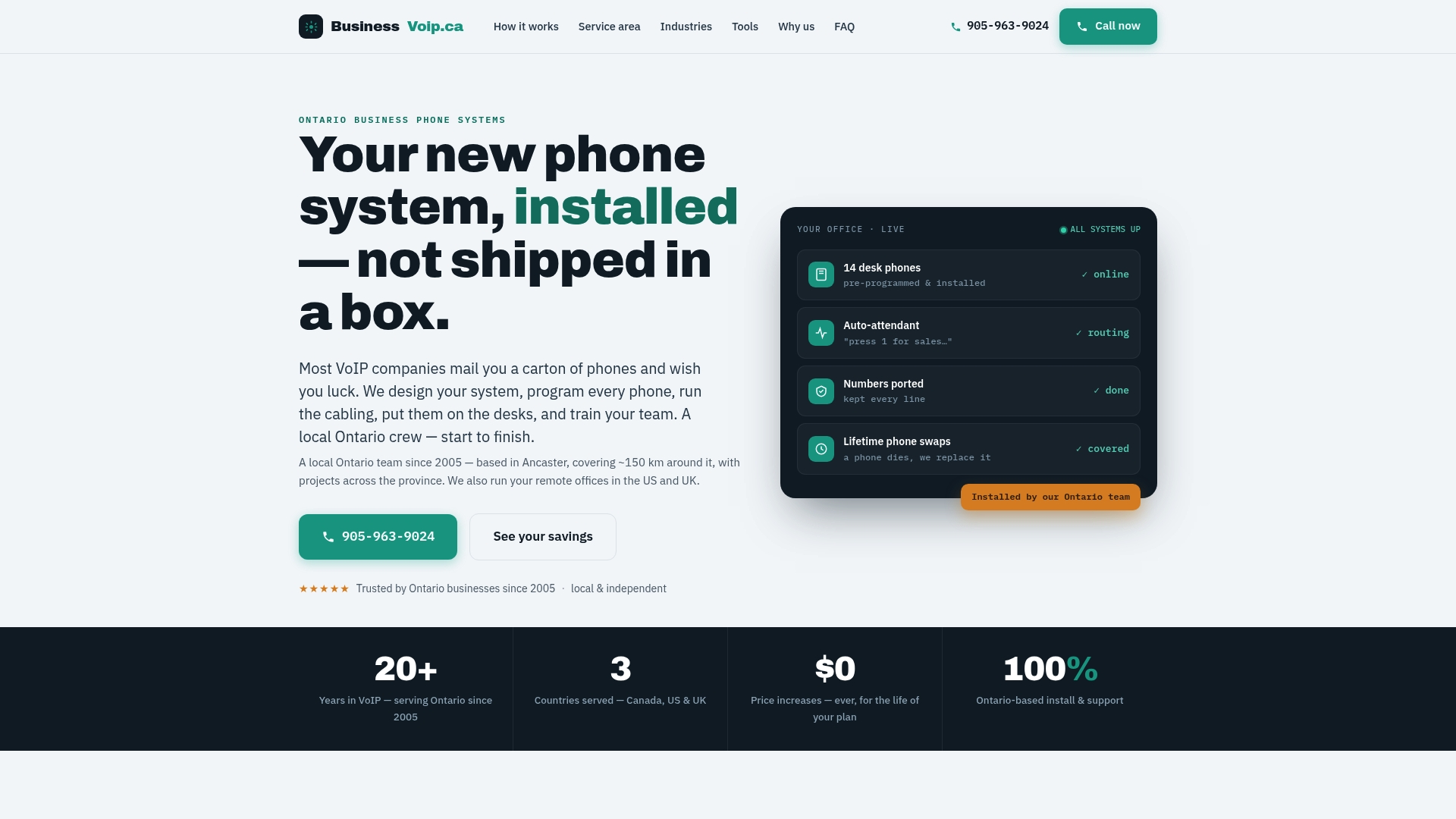
Getting these features right takes more than picking them off a menu: someone has to design the rules, check the network, program the system, and confirm E911 routing before go-live. A local team handles that entire sequence on-site, so a business doesn't have to piece it together from a manual.
That includes:
- System design and programming for after-hours routing, hunt groups, queues, and mobile forwarding.
- On-site cabling and installation so every phone and forwarding rule works from day one.
- E911 checks as part of the cutover, not an afterthought.
- Ongoing support and testing from the same team that installed the system.
Pricing is fixed to avoid surprise increases, and rented phones come with a warranty. If you're ready to map out forwarding rules for your office, start a design consultation with the team that will also install and support the result.
FAQ
What is the difference between conditional and unconditional call forwarding?
Unconditional forwarding sends every incoming call to another number automatically, with no exceptions. Conditional forwarding only reroutes calls under specific circumstances, such as a busy line, no answer, or a dead network connection, which keeps calls local until a rule actually applies.
How does call forwarding affect emergency 911 calls?
Forwarding can change which location or device an emergency call reaches, which affects where responders get dispatched. The CRTC requires VoIP providers to disclose these limitations and support E9-1-1 functionality where it's available, so any forwarding setup should be checked against your provider's emergency call procedure.
Can I forward business calls to a personal mobile phone?
Yes, a managed VoIP system can ring or forward calls to a mobile number through simultaneous ring or admin-controlled external forwarding. That forwarding should be set up by an administrator with access controls and monitoring in place, since open forwarding to external numbers is a known path for toll fraud.
Does call forwarding affect voicemail?
Voicemail routing works alongside forwarding rather than being replaced by it: a call that forwards and still goes unanswered typically falls through to voicemail, which can then deliver that message to email. That combination keeps a missed call from disappearing even after every forwarding rule has been tried.
What should I confirm with a VoIP provider before setting up forwarding?
Confirm centralized admin control over forwarding rules, documented E911 handling, and security controls like session border controllers and encrypted call signaling. These services are covered as part of an on-site design and installation process, with fixed pricing and no published cost beyond a direct quote.
Sources
- Telecom Decision CRTC 2005-28
- 9-1-1 obligations of local VoIP service providers in Canada | CRTC
- NIST Special Publication 800-58, Security considerations for voice over IP systems
- Voice over IP guidance (DHS attachment)
Regulatory and standards resources
- CRTC Telecom Decision 2005-28 on local VoIP regulation
- CRTC 9-1-1 obligations for VoIP providers
- NIST SP 800-58 on VoIP security
- DHS guidance on VoIP network security