
A cloud PBX is a cloud-hosted virtual phone system that replaces traditional on-premise hardware with software running on remote servers, as detailed by Call Time. Your phones, call routing, voicemail, and auto-attendant all live in the cloud. For Canadian businesses, that shift carries real weight: no capital equipment to buy, no maintenance contracts on aging hardware, and the ability to add or remove lines as your headcount changes.
The benefits that matter most to Ontario decision-makers include:
- Cost savings: No upfront PBX hardware, lower installation costs, and predictable monthly fees
- Location independence: Staff in Burlington, a remote office in Calgary, or a satellite location in the US can all share one phone system
- Scalability: Add a new line in minutes rather than waiting weeks for a technician
- Advanced features: Auto-attendant, call forwarding, voicemail-to-email, call recording, and mobile apps included at the base tier
- Regulatory fit: Canadian providers operate under CRTC oversight, which matters for data residency and number portability
Small and medium-sized Ontario businesses are adopting cloud telephony faster than ever because it delivers enterprise-level features without the enterprise-level price tag.
What features should you expect from a cloud PBX system?
Modern hosted phone systems come with a core feature set that would have cost a mid-market company a significant capital investment a decade ago. Auto-attendant greets callers and routes them without a receptionist. Call queues, ring groups, and hunt lists handle overflow. Voicemail-to-email transcribes messages and sends them to your inbox so nothing gets missed.
Beyond the basics, the features that separate good systems from great ones are:
- Mobile apps: Your desk phone number rings on your cell, so remote staff are never unreachable
- Call recording: Critical for compliance, training, and dispute resolution
- Conferencing: Built-in audio and video conferencing without a third-party subscription
- CRM and tool integration: Connect your phone system to Salesforce, Microsoft 365, or Google Workspace
- Platform neutrality: The best providers let you keep your existing IP phones or choose new hardware
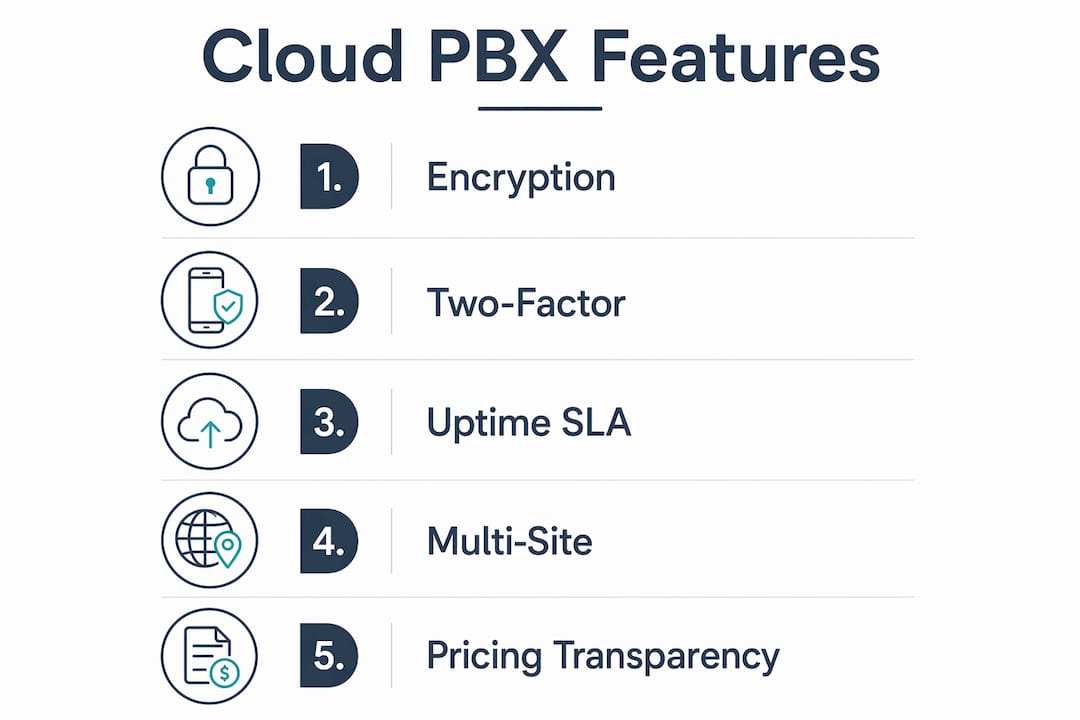
Security matters too. Look for TLS and SRTP encryption on call traffic, plus two-factor authentication on the admin portal. For Ontario businesses handling sensitive client data, ask whether the provider's servers are located in Canada. CRTC rules govern number portability, so any reputable provider should port your existing numbers without friction.
Pro Tip: Before signing a contract, ask the provider for their uptime SLA in writing. The best cloud PBX systems target 99.999% uptime, which translates to less than six minutes of downtime per year.

How do Ontario's top cloud PBX providers compare?
Eight verified Ontario providers serve the market in 2026, each with a distinct positioning. Here is how they stack up on the dimensions that matter most to IT managers and business owners.
| Provider | Google Rating | Core Services | Specialization | Best For |
|---|---|---|---|---|
| VoIP Much Phone Company Inc. | 4.8★ (132 reviews) | Business and home VoIP phone lines, calling features | Ontario-focused VoIP service | Businesses wanting reliable, feature-rich VoIP with strong local trust |
| IXICA Communications Inc. | 4.2★ (22 reviews) | Cloud PBX, SIP Trunking, dedicated business fibre | Enterprise and government connectivity, platform-neutral SIP | Medium to large enterprises needing fibre plus PBX in one relationship |
| Intratel Communications Inc. | 4.8★ (18 reviews) | Hosted PBX, on-premise PBX, call centre, VoIP lines | Hybrid hosted/on-premise, Canadian-owned | Organizations needing enterprise-class features with affordable Canadian support |
| SizLink Communications | 5★ (14 reviews) | Hosted/cloud PBX, managed IT, internet, IP phones | Fixed-price bundles, managed IT alongside telephony | SMBs wanting a single vendor for phones and IT support |
| cloudworx | 5★ (13 reviews) | Hosted PBX, on-premise IP PBX, SIP trunks, unified comms, cloud services | Full unified communications stack, Microsoft 365, IaaS | Businesses needing phone and cloud infrastructure from one provider |
| ClearlyCore Inc. | 5★ (4 reviews) | Hosted PBX, business IP phones, technical consulting, migration | Open-source telecom (Asterisk), 12+ years platform development | Cost-conscious organizations migrating from legacy systems |
| PBX Phone Systems | 5★ (1 review) | On-premise and hosted PBX, telephony services | Personalized local service in Ontario | Organizations seeking tailored telephony with hands-on attention |
| One PBX | — | Cloud PBX services | — | Contact for details |
VoIP Much Phone Company Inc. is the most reviewed provider on this list, with a track record built on straightforward business VoIP service for Ontario customers. Their focus is clean: reliable lines with calling features included, no complicated upsells.
IXICA Communications Inc. stands out for enterprises that need dedicated fibre internet alongside their PBX. Their platform-neutral SIP trunking means you can connect IXICA's trunks to almost any PBX you already own, and their free 30-day SIP Trunk demo lets you test before committing. Government and large enterprise clients are their stated sweet spot.
Intratel Communications Inc. covers the widest service range of any provider here: hosted PBX, on-premise PBX, call centre solutions, and VoIP lines, all from a Canadian-owned company. Their hybrid model is worth noting if you have legacy on-premise hardware you are not ready to retire.
SizLink Communications publishes the clearest pricing on the market. Their tiered plans start at $19.99 per month per line for a solo user, $49.99 per month for up to five users, $69.95 per month for up to ten users, and $149.95 per month for up to 25 users. Managed IT services are bundled alongside telephony, which suits smaller businesses that want one vendor to call.
ClearlyCore Inc. has spent over 12 years developing their own hosted PBX platform in Canada. They specialize in open-source telecom, including Asterisk, and claim average savings of 50% over traditional systems. Their technical consulting and migration support make them a strong fit when you are moving off a complex legacy setup.
cloudworx goes beyond telephony into full cloud infrastructure: Microsoft 365, SaaS, PaaS, IaaS, and unified communications all sit under one roof. For a business that wants to consolidate its phone system and cloud services with a single Ontario provider, that breadth is genuinely useful.
PBX Phone Systems and One PBX have limited public profiles. PBX Phone Systems focuses on personalized local service in Ontario. One PBX's service details are not publicly listed; contact them directly for specifics.
How to choose the right cloud PBX provider for your business
Start with a needs analysis before you talk to any vendor. Count your current lines, map your call flows, and identify which features your team actually uses versus which ones look good in a demo. Most businesses discover they need far fewer lines than they think once call queues and ring groups are configured properly.
Key criteria to evaluate:
- Feature fit: Does the system handle your call volume, IVR complexity, and integration requirements?
- Pricing transparency: Can the provider give you a written quote with no hidden per-feature fees?
- Contract terms: Month-to-month flexibility versus multi-year discounts. Know what the early termination clause looks like.
- Canadian data residency: If your clients are in regulated industries, confirm servers are located in Canada.
- Local support: Can a technician come on-site if something goes wrong, or is support limited to a remote help desk?
- Multi-site capability: If you have more than one office, verify the system handles inter-office calling and shared directories natively.
- CRTC compliance: Your provider should handle number portability and emergency 9-1-1 routing in line with CRTC requirements.
For Ontario businesses specifically, implementation timelines typically run two to four weeks from contract signing to go-live, assuming your internet connection meets the provider's bandwidth requirements. A pre-installation network audit is worth requesting from any provider before you commit.
Pro Tip: Ask every shortlisted provider for two or three reference clients in your industry. A provider who hesitates on that request is telling you something.

What does cloud PBX pricing look like in Canada?
Pricing for cloud-based PBX in Ontario generally follows a per-user or per-line monthly model. The table below reflects typical market tiers based on publicly available Canadian provider data.
| Plan Tier | Monthly Cost | Users Covered | Typical Features |
|---|---|---|---|
| Solo / Single Line | $19.99/line | 1 user | Basic calling, voicemail, call forwarding |
| Small Business | $49.99/month | Up to 5 users | Auto-attendant, ring groups, voicemail-to-email |
| Business Essential | $69.95/month | Up to 10 users | Conference calling, call recording, mobile app |
| Business Pro | $149.95/month | Up to 25 users | Advanced IVR, CRM integration, priority support |
| Medium Enterprise | Contact for quote | 25+ users | Custom SLAs, dedicated account management |
Pricing figures above reflect SizLink Communications' published tiers. Other Ontario providers use similar structures but may bundle features differently or charge per seat rather than per tier. Factors that push costs up include call recording storage, international calling bundles, and premium SLA commitments. Factors that bring costs down include multi-year contracts and porting your existing numbers rather than purchasing new ones. SizLink's Business Essential plan covers up to ten users at $69.95/month; plans for larger teams are priced at $149.95/month for up to twenty-five users.
The cost comparison with traditional on-premise PBX is not subtle. ClearlyCore reports significant average savings over legacy systems, and that figure aligns with what most hosted PBX buyers experience when they eliminate hardware refresh cycles and maintenance contracts.
Why local installation and support still matter in Ontario
A cloud PBX is only as good as the network it runs on and the team that sets it up. Plenty of Ontario businesses have signed up for a hosted phone service, received a box of IP phones in the mail, and spent weeks troubleshooting call quality issues because nobody audited their network first.
Businessvoip has operated in Ontario since 2005, serving businesses within roughly 150 km of Ancaster and taking on larger projects province-wide. Their model is different from a typical hosted provider: a local team designs the system, programs the call flows, cables the phones, and installs everything on-site so every handset works from day one. That includes number porting, after-hours routing, voicemail-to-email setup, staff training, and a network check before anything goes live.
Key trust signals worth noting:
- Fixed pricing with no annual increases, so your budget does not shift year over year
- Lifetime warranty on rented phones, eliminating hardware replacement costs
- Multi-site and remote office support, including clients with offices in the US and UK
- Carrier-grade infrastructure handling tens of thousands of business calls daily
For businesses that have been burned by a self-serve setup or a provider that disappeared after the sale, the on-site model addresses the exact problem that cloud-only providers leave open.
Businessvoip offers a fully installed alternative for Ontario businesses
If the providers compared above are cloud-first services you configure yourself, Businessvoip is the opposite: a fully installed, fully supported VoIP phone system where a local Ontario team handles every step from design to go-live.
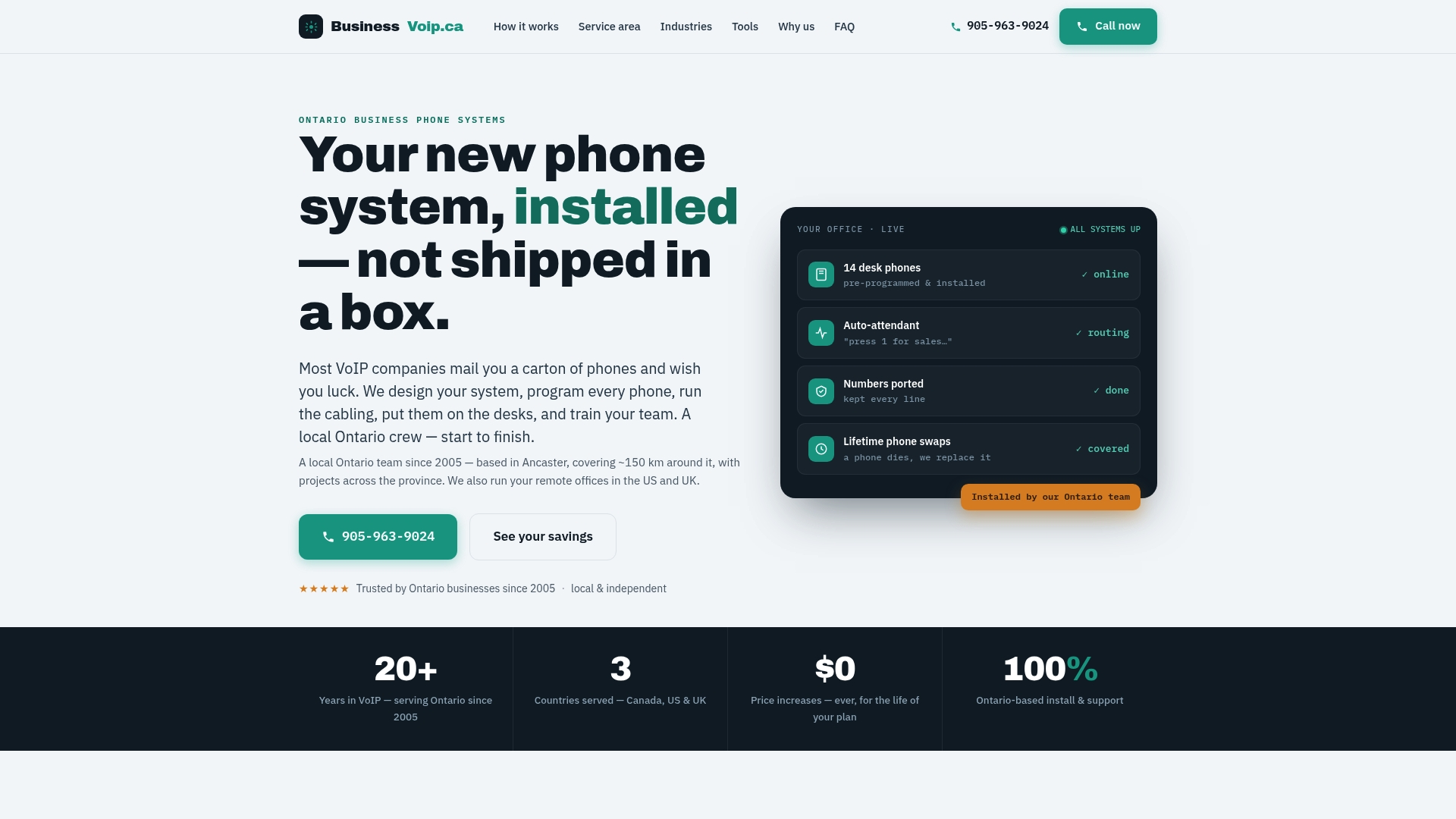
For multi-location businesses, the multi-site VoIP solution connects all your offices, including remote staff, under one system with shared directories and seamless inter-office calling. Fixed monthly pricing, lifetime warranties on rented phones, and a team that picks up the phone when something needs attention. If you want a system that works on day one without a learning curve, design your phone system with Businessvoip's local Ontario team.
Key Takeaways
Ontario businesses choosing a cloud PBX should prioritize Canadian data residency, transparent per-user pricing, and a provider with genuine on-site support capability rather than remote-only service.
| Point | Details |
|---|---|
| Cloud PBX replaces hardware | All call routing, voicemail, and features run in the cloud with no on-premise equipment required. |
| Pricing starts at $19.99/line | Ontario providers publish tiered plans: solo at $19.99/line, $49.99/month for up to five users, $69.95/month for up to ten users, and $149.95/month for up to twenty-five users, with costs rising based on users and features. |
| ClearlyCore's 50% savings claim | Switching from legacy PBX to a hosted system can cut telephony costs significantly over a multi-year period. |
| CRTC compliance is non-optional | Any Canadian provider must handle number portability and 9-1-1 routing per CRTC requirements. |
| Businessvoip installs on-site | Unlike self-serve cloud providers, Businessvoip designs, programs, and installs the full system for Ontario businesses. |