
An analog telephone adapter or analog gateway converts the electrical signal from a phone, fax, or POS terminal into SIP and RTP packets that an IP network can carry. Use T.38 for fax and G.711 for voice as fallback. The pragmatic path is a phased rollout: pilot a handful of ATAs, confirm your QoS settings hold up under real traffic, then scale to the rest of the building.
TL;DR:
- Ensuring QoS settings such as DSCP tagging and dedicated VLANs is crucial to prevent packet loss, jitter, and latency that disrupt analog device performance over VoIP.
- For larger setups, gateway hardware supporting multiple FXS ports and centralized management simplifies scaling and reduces the risk of misconfiguration.
- Testing a single ATA extensively before full deployment helps identify firmware quirks and ensures compatibility with your PBX or SIP trunk, especially for sensitive devices like fax and POS terminals.
- Professional, on-site installation that includes network design, device configuration, and comprehensive testing offers more reliable integration than DIY approaches, preventing costly disruptions.
Table of Contents
- How Analog Devices With VoIP Actually Connect
- Which Analog Devices Still Belong on Your Network
- Choosing the Right ATA or Gateway for Your Setup
- FXS, FXO, SIP, and Codecs: The Terms That Trip People Up
- Building a Configuration Checklist That Actually Holds Up
- Why Fax Breaks First, and What to Do About It
- A Phased Migration Checklist for Legacy Analog Devices
- Troubleshooting: What to Measure and How to Read It
- Why Managed On-Site Installs Beat DIY ATA Deployment
- Get Your Analog Lines Properly Integrated, Not Just Plugged In
- Reference Datasheets and Standards Worth Bookmarking
- Sources
- FAQ
How Analog Devices With VoIP Actually Connect
The signal path is short but every link matters. An analog phone, fax, or terminal plugs into an FXS port on an ATA or gateway using a standard RJ11 cable. That box digitizes the analog signal, wraps it in RTP media packets, and hands call setup duties to SIP. From there it travels your LAN, out to the internet or a private circuit, and lands on your PBX or SIP trunk.
SIP handles the handshake, ringing, and call teardown. RTP carries the actual audio (or fax tones) once the call connects. The codec you pick, most commonly G.711, determines how much bandwidth each call needs and how tolerant it is of compression artifacts.
Analog gear was never built to expect network jitter, so packetization introduces three failure modes worth knowing before you deploy anything:
- Packet loss drops audio slices, which sounds like clipped words on a voice call and can corrupt fax tones entirely.
- Jitter (uneven packet arrival) forces the receiving device to buffer, adding delay or causing choppy audio if the buffer runs dry.
- Latency above roughly 150 milliseconds one way makes conversations feel laggy and can break the timing-sensitive handshake that fax machines rely on.
None of this is exotic. It's the same reason a video call stutters on a bad Wi-Fi connection, just applied to a technology designed in an era when the phone network guaranteed a clean, dedicated circuit for every call.
Which Analog Devices Still Belong on Your Network
Most offices carry more analog gear than they realize, and not all of it needs replacing just because the phone system went digital. The usual candidates:
- Standard desk phones in break rooms, lobbies, or backup locations.
- Fax machines, still common in legal, medical, and logistics operations.
- POS terminals that dial out for card authorization over a phone line.
- Overhead paging systems in warehouses, schools, and retail floors.
- TTY devices for accessibility compliance.
Each connects to an ATA or gateway's FXS port with a plain RJ11 cable, the same jack that's been on phones for decades. Most small-office ATAs offer between one and four FXS ports, so a four-line unit can cover a phone, a fax, and a paging amplifier without adding a second box, according to Cisco's ATA 191 data sheet.
Fax and POS terminals are the touchiest of the group. They depend on precise signal timing that packet networks don't naturally preserve. Paging systems are more forgiving. A half-second of latency on an announcement rarely matters, but it will wreck a fax transmission.
Choosing the Right ATA or Gateway for Your Setup
Hardware choice comes down to scale, not brand preference. A single analog line in a small office, say one fax machine at a satellite location, is a fine job for a single-port ATA. Once you're covering a phone, fax, and paging amp in one location, a four-port ATA keeps cabling and management simpler than three separate boxes. Beyond eight or twelve analog lines, you're in gateway territory, and that's where products like the Patton SmartNode SN200 series come in, supporting up to four FXS ports per unit with the option to stack multiple units under one management interface.
Here's a rough decision order for sizing hardware:
- Count your actual analog endpoints across every site, not just the main office.
- Group them by location and pick single or multi-port ATAs for anything under eight lines per site.
- Move to a gateway platform once a single location needs more ports than a multi-port ATA reasonably covers, or once you need centralized management across multiple sites.
- Confirm provisioning support (zero-touch or cloud-based) if you're deploying more than a handful of units, since manually configuring each device does not scale.
- Verify Canadian availability and support before committing, since not every vendor stocks or services every model in every region.
Security deserves equal weight to port count. Require SIP-TLS for signaling encryption and SRTP for media encryption on anything handling sensitive calls, and confirm T.38 support if fax is in the mix at all. Vendor documentation for platforms like the SmartNode SN200 line out SIP, T.38, and SRTP support as standard features, which is the baseline you should be shopping for, not a premium add on.
Pro Tip: Before buying a batch of ATAs, test one unit against your actual PBX or SIP trunk for two weeks. Firmware quirks between vendors show up in ways a spec sheet never will.
FXS, FXO, SIP, and Codecs: The Terms That Trip People Up
Two acronyms cause more misconfigurations than everything else in this guide combined. FXS (Foreign Exchange Station) is the port that supplies a dial tone and ringing voltage. It's what your analog phone, fax, or POS terminal plugs into. FXO (Foreign Exchange Office) is the port that receives a line, typically used when a gateway needs to accept an incoming PSTN circuit. Plugging a phone into an FXO port, or trying to feed a phone line into an FXS port, is the single most common setup mistake in small deployments.
Protocol choice matters just as much:
- T.38 is the purpose-built fax-over-IP standard. It converts fax tones into structured data instead of trying to push raw audio through a lossy network, which is why it's the recommended path for fax reliability.
- G.711 is the fallback when T.38 negotiation fails or isn't supported end to end. It passes fax tones as regular audio, which works, but only if the network path is close to pristine.
- Codec selection for voice trades bandwidth against quality. G.711 sounds better but uses more bandwidth per call; compressed codecs save bandwidth but can introduce artifacts that confuse fax and POS modems.
- DTMF transport (the tones a POS terminal or IVR menu depends on) can travel as RFC2833 events, SIP INFO messages, or raw in-band audio. Mismatched DTMF modes between your ATA and PBX are a frequent, and frequently misdiagnosed, cause of POS transactions silently failing.
Get FXS/FXO backwards or leave DTMF mode unset, and you'll spend hours troubleshooting what looks like a network problem but is actually a one-line configuration fix.
Building a Configuration Checklist That Actually Holds Up
Most analog-over-VoIP failures trace back to a handful of settings that never got touched during setup. Work through these in order, starting with the network and moving down to the device:
- Mark voice traffic with DiffServ (DSCP) tags and apply 802.1P/Q tagging so switches and routers treat call packets as priority traffic, not best-effort data.
- Put voice on its own VLAN so a file transfer or backup job on the data VLAN can't starve call quality during business hours.
- Apply WAN-level QoS on your router or firewall, especially if you're on a shared internet circuit rather than a dedicated line.
- Enable T.38 on every ATA and gateway that supports it, and set G.711 as the fallback codec specifically for fax ports rather than a compressed codec.
- Size the jitter buffer appropriately. Too small and you get choppy audio under light network stress; too large and you introduce noticeable delay. Start with the vendor default and adjust only after you've measured real jitter on your network.
- Set DTMF mode explicitly to match what your PBX expects, RFC2833 is the most broadly compatible choice for most deployments.
- Confirm clean power and cabling to every ATA. Analog gear is sensitive to voltage inconsistency in a way IP phones simply aren't.
- Set up call quality monitoring so degraded MOS scores or rising packet loss show up before a user complains.
- Keep a PSTN failover path for critical lines (alarm systems, elevator phones, fax) during the transition period, so a network outage doesn't take down life-safety equipment.
Pro Tip: Label every ATA physically with its port assignments and VLAN ID. Six months from now, whoever troubleshoots a dead fax line will thank you for not having to trace cables through a ceiling.
Why Fax Breaks First, and What to Do About It
Fax is the canary in the coal mine for any analog-over-VoIP deployment, and it's usually the first thing to fail. The T.30 fax protocol was built for a clean, dedicated circuit with predictable timing. Even a small amount of packet loss can throw off that timing enough to break the negotiation entirely, which is the core reason fax is the most fragile analog use case on a packetized network.
The fix, in order of preference:
- Enable T.38 everywhere it's supported, on the ATA, the gateway, and the receiving end. It converts fax data into a format built to survive IP transport instead of fighting it.
- Fall back to G.711 passthrough only when T.38 isn't available end to end, and only on a network path with strong, verified QoS.
- Disable ECM (Error Correction Mode) on the fax device when running G.711 passthrough. ECM was designed for clean analog circuits, and on a lossy packet network it tends to trigger repeated retransmission attempts that stall the call rather than fixing it.
- Lower the fax baud rate if your machine allows it. A slower transmission rate tolerates jitter better than a fast one.
If a location sends high volumes of fax traffic, or the content is sensitive enough that a failed transmission is a real problem, cloud fax (FoIP) services are usually the more dependable answer instead of fighting an aging fax machine through an ATA. Businessvoip's own guidance on fax over VoIP reliability covers configuration specifics worth reviewing before you commit either way.
A Phased Migration Checklist for Legacy Analog Devices
Don't rip out every analog line on day one. A staged approach catches problems while the blast radius is still small.
- Audit every analog device across every site and categorize each one by criticality (life-safety, revenue-generating, convenience) and by likely compatibility (a modern fax vs. a decade-old POS modem).
- Pilot with ATAs on your most critical devices first, not your least important ones. If a paging system pilot goes fine but your fax line breaks, you want to know that before the whole building depends on it.
- Run real test calls and fax transmissions during the pilot, measuring packet loss, jitter, and one-way latency the entire time, not just spot-checking after the fact.
- Roll out in phases by site or floor, monitoring quality metrics after each phase rather than moving to the next batch immediately.
- Keep a documented rollback plan for each phase, since a network change elsewhere in the building can degrade a connection that tested fine a month earlier.
- Decommission PSTN lines only after the replacement has run clean for a defined period, not the day the new ATA goes live.
Pro Tip: Run your fax pilot at the same time of day your actual fax volume peaks. A quiet 10 a.m. test tells you nothing about how the line behaves during a busy afternoon when the network is under real load.
If you're planning this across multiple locations, the sequencing matters even more. Businessvoip's guidance on phone system migration without downtime and office move phone planning both walk through cutover sequencing that applies directly to analog device migrations.
Troubleshooting: What to Measure and How to Read It
When an analog device misbehaves on VoIP, guessing wastes time. Measure these four metrics first:
- Packet loss (target under 1% for voice, near zero for fax)
- Jitter (ideally under 30 milliseconds)
- One-way latency (under 150 milliseconds)
- MOS or R-factor, a composite call-quality score that gives you a single score to track over time
| Symptom | Likely cause | Where to look |
|---|---|---|
| Choppy voice, dropped words | Packet loss or jitter | Packet capture on the ATA's WAN interface |
| Fax fails to connect at all | Fax negotiation failure | SIP trace, check for fax capability mismatch |
| Fax connects but garbles mid-page | ECM retransmission loop over lossy path | Disable ECM, check jitter buffer size |
| POS terminal dials but tones don't register | DTMF mode mismatch | Compare ATA and PBX DTMF settings (RFC2833 vs SIP INFO) |
A packet capture combined with a SIP log almost always reveals whether the problem is a codec mismatch, a failed T.38 handshake, or a DTMF transport disagreement between the ATA and your PBX. Run the fax test pattern at both ends and read the negotiation result. If it drops from T.38 to G.711 mid-call, that's your network telling you the QoS marking isn't holding.
Why Managed On-Site Installs Beat DIY ATA Deployment
A DIY ATA rollout usually goes fine for the phone in the break room. It goes badly for the fax machine that handles signed contracts, because nobody validated T.38 negotiation before go-live. Businessvoip has spent years running on-site installs across Ontario, and the pattern is consistent: the failures that show up months later almost always trace back to a QoS setting or a port assignment nobody tested under real load during setup.
A managed install differs from a box shipped to your door in one practical way: someone designs the network, programs every device, cables the ports, and tests each analog line before handing it back to you. That means fax tests, paging tests, and POS DTMF verification happen before the old lines get decommissioned, not after a complaint comes in. Rented phones carry a lifetime warranty, and staff get trained on the actual system they'll be using, not a generic manual.
— James
Get Your Analog Lines Properly Integrated, Not Just Plugged In
Businessvoip is the alternative to guessing your way through an ATA rollout: instead of ordering hardware online and troubleshooting fax failures after the fact, an Ontario-based team designs, programs, cables, and tests every analog port on-site before your old lines go dark. That matters most for the devices this guide just covered, fax, POS, paging, where a missed T.38 setting or DTMF mismatch turns into a real business disruption instead of a minor annoyance.
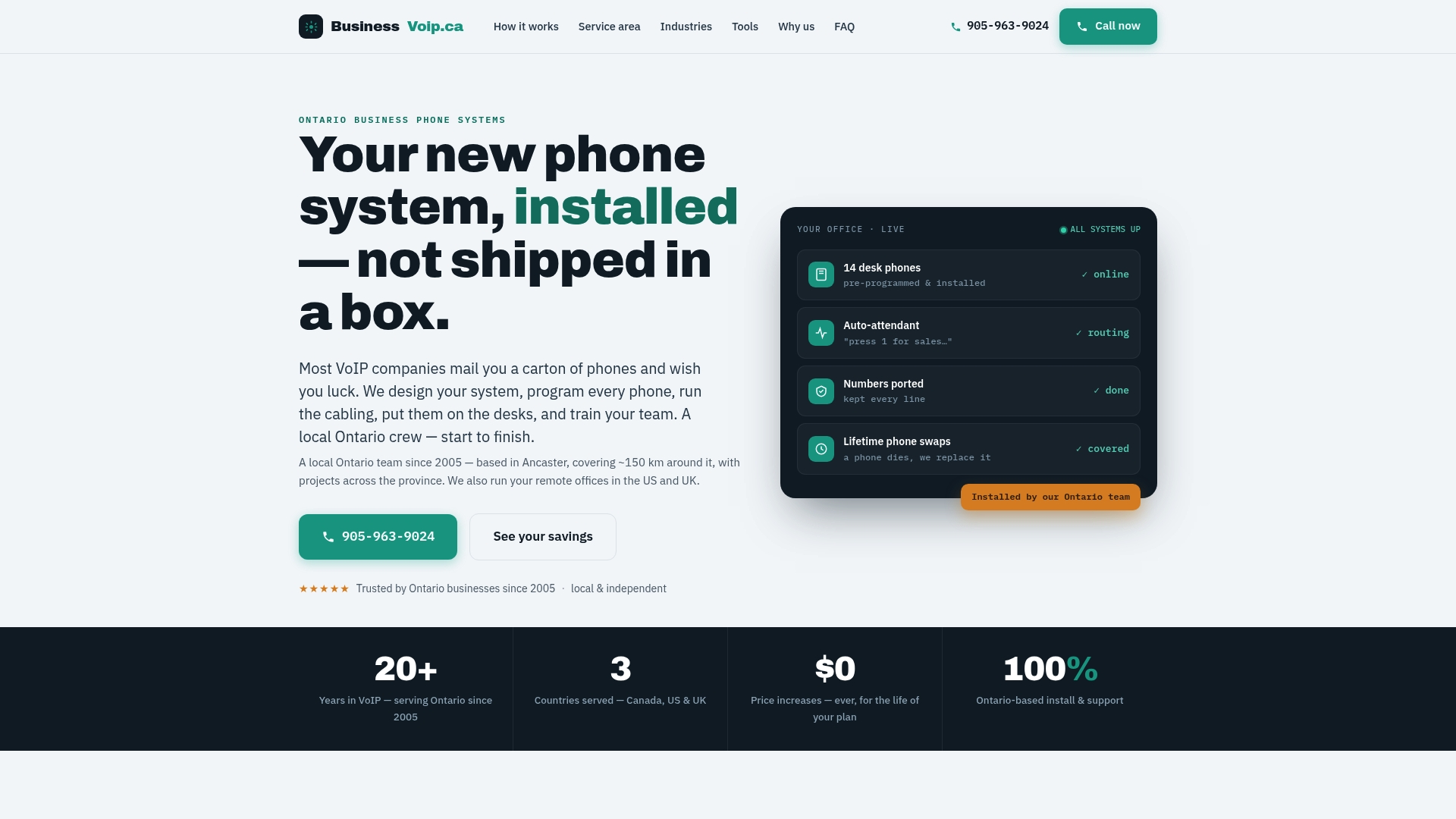
Businessvoip's installers handle the full path: designing the network for voice traffic, programming FXS ports correctly the first time, running the fax and QoS tests this article describes, and training your staff on the finished system. Rented phones come with a warranty. If you're weighing this against a broader multi-site rollout, the multi-site and remote office deployment page covers how that scales across locations.
If your organization also runs branded IVR prompts or custom greetings alongside the analog migration, VoiceBros' phone system voice-over service is worth a look for that piece specifically.
Ready to get an honest read on your analog lines before you buy a single ATA? Request a phone system design consultation and get a site assessment that catches the fax and POS issues before they cost you a transaction.
Reference Datasheets and Standards Worth Bookmarking
- Cisco ATA 191 Analog Telephone Adapter data sheet
- Patton SmartNode SN200 series product pages
- Grandstream analog telephone adaptors
- Yeastar: Analog Telephone Adapter
- Fax with VoIP: everything you need to know
Sources
FAQ
What are five examples of analog devices used with VoIP?
Standard desk phones, fax machines, POS terminals, overhead paging systems, and TTY devices for accessibility compliance are the most common analog endpoints connected through an ATA or gateway.
Does anyone still use VoIP with analog equipment?
Yes. Most businesses migrating off traditional phone lines keep at least one analog device, usually a fax machine or paging system, running through an ATA rather than replacing it outright.
What is the main disadvantage of VoIP for analog devices?
Packetization introduces jitter, latency, and packet loss that analog gear, especially fax machines, was never designed to tolerate, which is why fax-over-IP standards and proper QoS configuration matter so much.
How can I convert my analog phone to VoIP?
Plug the analog phone into an FXS port on an ATA or gateway using an RJ11 cable; the ATA converts the signal to SIP and RTP packets and registers with your PBX or SIP trunk. For a multi-line office, a managed install like Businessvoip's on-site service handles the port assignment, QoS setup, and testing so nothing gets missed.