
VoIP phone service for business is defined as a communication system that routes voice calls over the internet instead of traditional copper phone lines. Ontario businesses that switch from legacy PBX systems to internet-based telephony consistently report lower monthly costs, greater flexibility across locations, and features that traditional carriers simply cannot match. The industry term is Voice over Internet Protocol, or VoIP, and understanding it is the first step toward making a confident buying decision. Businessvoip has delivered fully installed, carrier-grade VoIP systems to Ontario businesses since 2005, and the difference between a properly deployed system and a self-installed box of phones is significant.
What features define an effective VoIP phone service for business?
The core features every business VoIP phone service must include are call routing, auto attendant, voicemail to email, and call forwarding. These four functions replace the basic capabilities of a traditional phone system while adding flexibility that physical hardware cannot provide. Without them, your team will spend time manually managing calls that should route automatically.
Advanced functionality separates entry-level systems from platforms built for growth. AI call handling reduces missed contacts by automating call answering, filtering spam, and routing calls to the right team member instantly. An AI receptionist acts as a 24/7 gatekeeper, which directly improves lead capture and response times without adding headcount.

Call transcription and CRM integration are the next tier of features worth prioritizing. When a call ends and a summary automatically syncs to your customer record, your team skips manual note-taking entirely. That time compounds across dozens of calls per day. Shared inboxes and call summaries are now standard in modern business VoIP phone services, not premium add-ons.
Security and reliability features protect business continuity. Look for end-to-end encryption, redundant data centers, and uptime guarantees backed by a service level agreement. A system that drops calls during peak hours costs more in lost business than any monthly subscription fee.
- Call routing and auto attendant: Directs callers to the right department without a receptionist.
- Voicemail to email: Delivers audio files and transcripts directly to your inbox.
- AI receptionist: Answers calls 24/7, filters spam, and captures leads automatically.
- CRM integration: Syncs call data and summaries to your customer records in real time.
- Mobile app support: Lets your team take business calls from any device, anywhere.
- Encryption and uptime SLA: Protects call quality and data security across all locations.
Pro Tip: Before signing any contract, ask the provider to demonstrate call routing configuration live. A system that requires a technician to change a call flow every time your hours change is not built for your business.
How does a mobile-native VoIP system benefit small to mid-sized businesses?
Mobile-native VoIP systems are now the standard for SMBs that need to stay flexible and professional across changing work environments. The shift matters because a mobile app as the primary interface removes the dependency on desk phones, office wiring, and physical locations entirely. Your team's business number travels with them.
The practical benefit for distributed teams is significant. A sales rep driving between client sites in Mississauga and Hamilton can answer calls on their cell phone under the company's main number, transfer to a colleague in the office, and check a voicemail transcript before walking into a meeting. That workflow requires zero hardware beyond a smartphone.
Maintaining professional identity without hardware dependence is one of the clearest advantages of mobile-first VoIP design. Customers always see your business number on caller ID, regardless of which device your team member uses. The separation between personal and professional calls stays intact.
For multi-site businesses, mobile-native design solves a problem that traditional systems handle poorly. Connecting a satellite office in Kitchener to a head office in Burlington used to require expensive inter-office trunk lines. With a mobile-native IP phone service for business, both locations share the same phone system through an app, and calls between sites cost nothing extra.
- Employees answer business calls from home, the office, or on the road without switching devices.
- New team members get a business number activated in minutes, not days.
- Remote offices in different cities or provinces connect to the same system instantly.
- Businesses avoid the capital cost of desk phones, cabling, and on-site PBX hardware.
What are the typical costs and pricing models for VoIP phone services?
Flat-rate per-user pricing is the most transparent model available for business VoIP phone services. One published example is a flat rate of $32 per user that includes unlimited calling and all AI features with no add-ons or contracts. That structure lets finance teams forecast communication costs with certainty, which matters when you are managing budgets across multiple departments or sites.
The hidden fee problem is real and common. Many providers advertise a low base rate, then charge separately for call recording, auto attendant, additional phone numbers, and international calling. A $15 per user headline price can easily reach $40 per user once those add-ons appear on the first invoice. Predictable billing enables reinvestment into growth. When your phone bill does not fluctuate, you can plan hiring and equipment purchases with confidence.
Pro Tip: Request a fully itemized quote that includes every feature your team will actually use. Compare the all-in monthly cost, not the advertised base rate.
| Pricing model | What to watch for |
|---|---|
| Flat-rate per user | Confirm all features are included, not tiered behind higher plans |
| Per-minute billing | Costs spike unpredictably during busy periods or sales campaigns |
| Contract with minimums | Early termination fees and seat minimums can lock you into paying for unused lines |
| Add-on pricing | Recording, extra numbers, and AI features often cost extra on base plans |
Businessvoip uses fixed pricing with no annual increases, which means the rate you agree to on day one stays the same. For Ontario businesses managing tight margins, that predictability is a concrete financial advantage.
How to implement VoIP phone service across multiple sites and teams
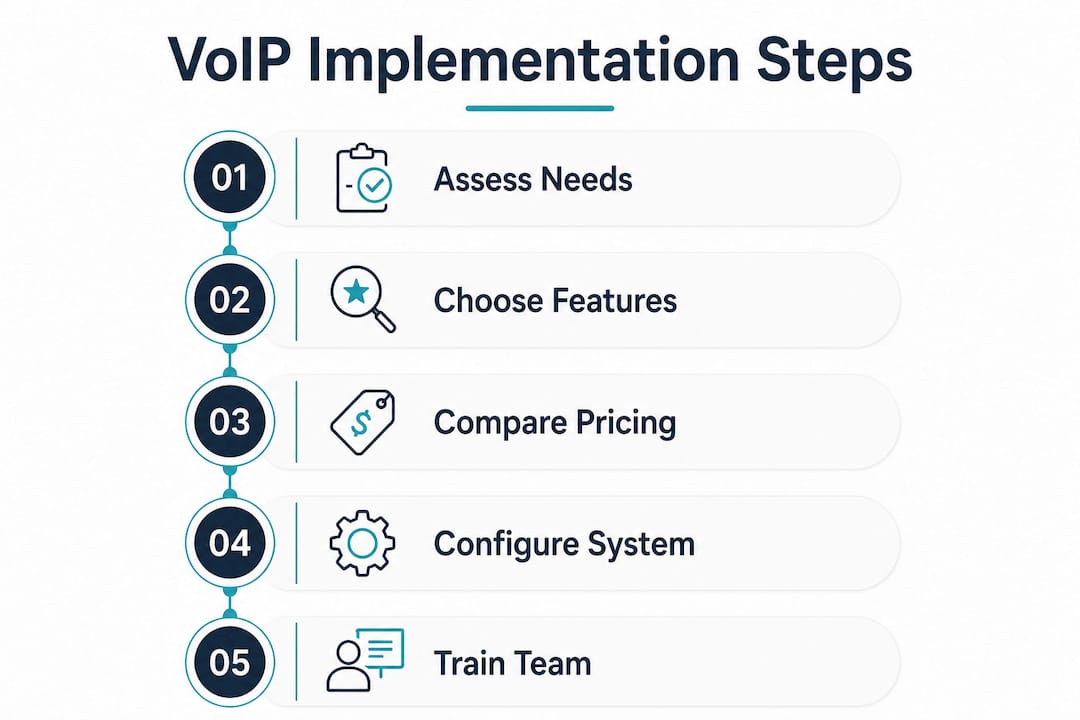
A structured deployment process prevents the most common problems: dropped calls, missed number ports, and undertrained staff. Follow these steps to get your business VoIP phone service running correctly from the start.
-
Audit your internet connection first. VoIP call quality depends directly on bandwidth and latency. Run a speed test at each location and confirm your router prioritizes voice traffic through Quality of Service settings. A single congested connection can degrade call quality for the entire office.
-
Port your existing numbers before go-live. Number porting to VoIP is a standard process that good providers manage entirely on your behalf. Your customers keep calling the same number, and the transition happens without a gap in service. Never cancel your old service before the port completes.
-
Choose devices based on your team's actual workflow. Mobile-native systems let your team use existing smartphones, which eliminates hardware procurement delays. Businesses that need physical desk phones can add IP handsets to the same system without running separate infrastructure.
-
Configure call routing before your first live call. Set up your auto attendant, business hours, and call queues in the admin portal before switching over. Test every route by calling in from an external number. A misconfigured auto attendant on day one creates a poor first impression that is hard to undo.
-
Train your team on AI features specifically. Call transcription, shared inboxes, and AI summaries only deliver value when your team knows how to access and act on them. Schedule a 30-minute walkthrough on launch day. Teams that skip training use roughly half the features they are paying for.
-
Connect remote offices to the same system. For multi-site VoIP deployments, each location joins the same cloud phone system. Internal calls between sites are free, and your main number rings across all locations based on the routing rules you set.
Businessvoip handles the design, programming, cabling, and on-site installation for Ontario businesses, so every phone works from day one. That matters most for multi-site operations where a single misconfigured site can disrupt the entire network.
Key Takeaways
A properly deployed VoIP phone service for business combines mobile-native flexibility, AI-driven call handling, transparent flat-rate pricing, and structured multi-site implementation to deliver reliable, cost-efficient communication.
| Point | Details |
|---|---|
| Core features matter most | Prioritize call routing, auto attendant, AI handling, and CRM integration before evaluating price. |
| Mobile-native design wins | A smartphone-first system removes hardware dependency and connects remote teams instantly. |
| Flat-rate pricing protects budgets | All-in per-user pricing prevents invoice surprises and supports accurate financial planning. |
| Number porting is non-negotiable | Port existing numbers before go-live so customers never experience a gap in service. |
| Multi-site setup needs structure | Audit internet connections, configure routing, and train staff before switching over. |
What I've learned after watching businesses get VoIP wrong
The most common mistake I see Ontario businesses make is treating VoIP as a plug-and-play commodity. They sign up for a low-cost plan, receive a box of phones, and spend the first two weeks troubleshooting call quality issues, missed routes, and confused staff. The technology is not the problem. The deployment is.
AI features are where the real productivity gains live, and most businesses leave them completely unused. An AI receptionist that answers calls at 2:00 AM, captures a lead's contact details, and routes a follow-up to the right salesperson the next morning is not a novelty. It is a measurable improvement in lead capture that requires zero additional staff. Teams that configure these features on day one see the return immediately.
Mobile-native design has genuinely changed what is possible for distributed businesses. I have seen a five-person company in Hamilton manage calls across three provinces using nothing but smartphones and a well-configured cloud system. The old assumption that a "real" phone system requires racks of hardware in a server room is simply outdated.
The pricing transparency issue is the one I feel most strongly about. Hidden fees are not a minor inconvenience. They erode trust and make it impossible to budget accurately. Any provider that cannot give you a complete all-in monthly cost per user before you sign is telling you something important about how they operate.
My recommendation for any Ontario SMB evaluating cloud-based phone systems is to prioritize ease of setup, transparent pricing, and a provider that handles installation. The technology works. The question is whether your provider will make sure it works for you.
— James
Businessvoip's approach to multi-site VoIP in Ontario
Ontario businesses with multiple locations face a specific challenge: keeping every site connected, every call routed correctly, and every team member reachable without managing separate phone systems per location.
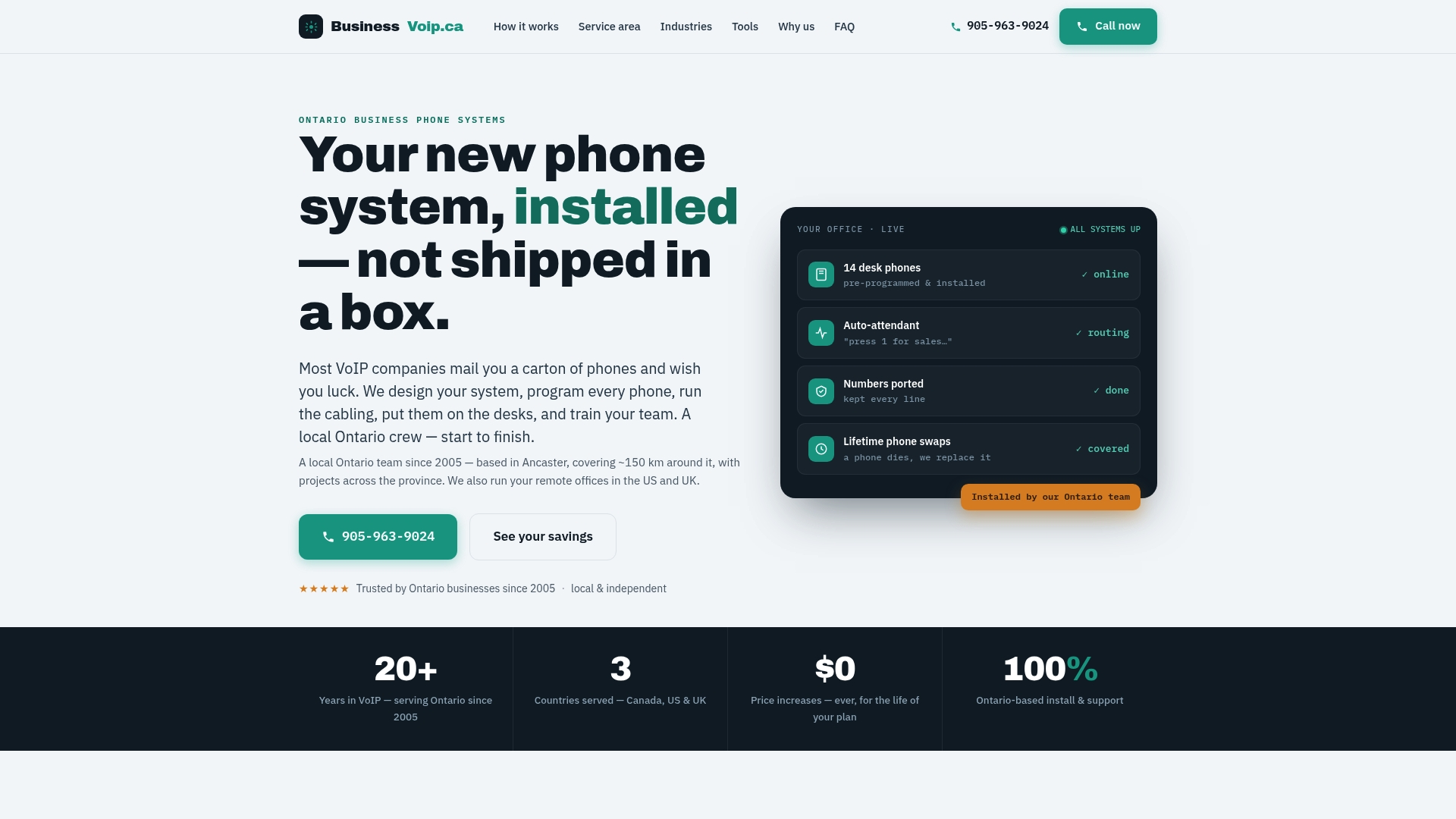
Businessvoip designs, programs, cables, and installs VoIP systems on-site across Ontario, serving businesses within roughly 150 km of Ancaster and taking on larger projects province-wide. Fixed pricing means no annual increases, and rented phones carry a lifetime warranty. For businesses with multi-site and remote office needs, Businessvoip builds a single unified system that connects every location from day one. If you want a system designed specifically for your business, the phone system designer tool walks you through the options in minutes.
FAQ
What is VoIP phone service for business?
VoIP phone service for business is a communication system that routes voice calls over the internet rather than traditional phone lines. It replaces legacy PBX hardware with cloud-based software that supports calling, routing, voicemail, and AI features from any device.
How much does a business VoIP phone service cost?
Pricing varies by provider and feature set. Transparent flat-rate models charge a fixed amount per user per month with all features included, while other providers charge a low base rate and add fees for recording, extra numbers, and AI tools.
Can I keep my existing business phone number when switching to VoIP?
Number porting is a standard process that VoIP providers manage on your behalf. Your existing business number transfers to the new system without a gap in service, provided you do not cancel your old service before the port completes.
Does VoIP work well for businesses with multiple locations?
VoIP is particularly well suited for multi-site businesses because all locations share one cloud phone system. Internal calls between sites are free, and call routing rules apply across the entire organization from a single admin portal.
What internet connection does VoIP require?
VoIP requires a stable broadband connection with sufficient bandwidth and low latency at each location. Enabling Quality of Service settings on your router prioritizes voice traffic and prevents call quality issues during periods of high internet usage.