Yes, VoIP calls can be genuinely private, but only when both the signaling and the audio are encrypted, not just one or the other. The fastest fix for most people is switching to a provider and set of endpoints that enforce TLS plus SRTP by default, then keeping those endpoints updated. If you need a guarantee that not even your provider can listen in, add end-to-end encryption or a VPN on top, and accept that some convenience features may disappear as a result.
TL;DR:
- Encrypt both signaling and media streams with TLS and SRTP to prevent eavesdropping and protect call metadata from being exposed.
- Use strong, rotated credentials, restrict SIP access with IP whitelists, and implement multi-factor authentication to minimize theft and unauthorized access risks.
- Verify encryption protocols through packet captures and configuration checks, avoiding systems that only encrypt either signaling or media but not both.
- Deploy end-to-end encryption only when provider-proof privacy is necessary, but prioritize correct setup of TLS and SRTP first to mitigate most common vulnerabilities.
- Confirm provider policies on data retention, encryption key control, and incident response before choosing a VoIP provider, ensuring they meet your privacy requirements.
Table of Contents
- Common Privacy Risks That Put VoIP Calls at Risk
- Signaling vs. Media: How VoIP Encryption Actually Works
- A Step-by-Step Privacy Checklist for VoIP Calls
- Questions to Ask Before Choosing a Privacy-Conscious VoIP Provider
- Who's Behind This Advice
- Where to Verify These Standards Yourself
- What Actually Matters Once You Cut Through the Noise
- Sources
Common Privacy Risks That Put VoIP Calls at Risk
Most VoIP privacy failures don't come from elite hacking operations. They come from unencrypted defaults that nobody bothered to turn off.
Open Wi-Fi at a coffee shop or shared office LAN lets anyone running a packet sniffer capture raw RTP media streams and reconstruct audio if that traffic isn't encrypted. Plain SIP signaling is often worse for privacy even when audio is protected, because it broadcasts call metadata in the clear: who called whom, when, and for how long. That metadata alone can map out business relationships, client lists, and call patterns.
Beyond eavesdropping, there's theft. Toll fraud and stolen SIP credentials let attackers place calls on your account and your dime, sometimes racking up thousands in charges before anyone notices. And even when a provider protects call content properly, it still typically logs call detail records for billing and support purposes. That's metadata, not your conversation, but it's still a privacy exposure worth understanding before you sign a contract.
The financial stakes here aren't abstract. Average breach costs tracked by Statista show why organizations increasingly treat voice traffic with the same seriousness as email and file storage. A compromised phone system is a data breach with a dial tone.
- Unencrypted RTP on shared networks can be captured and replayed as audio.
- Cleartext SIP signaling exposes caller ID, timestamps, and call duration.
- Stolen SIP credentials enable toll fraud on your account.
- Call detail records are retained by most providers regardless of content encryption.
Signaling vs. Media: How VoIP Encryption Actually Works
VoIP calls travel over two separate streams, and encrypting one does nothing for the other. SIP signaling handles call setup, routing, and teardown. RTP media carries the actual audio. A system can lock down one and leave the other wide open, which is exactly what happens on a lot of poorly configured phone systems.
SIP-TLS (sometimes shown as sips: in a URI) encrypts the signaling channel, hiding who's calling whom from anyone watching the network. SRTP encrypts the audio itself, and it comes in a few flavors. SDES carries encryption keys inside the SDP payload, which means it depends entirely on TLS to protect those keys in transit. DTLS-SRTP and zRTP handle key exchange directly between endpoints, giving you stronger endpoint-based assurance that doesn't rely on the signaling layer staying secure.
Industry guidance is consistent on one point: TLS and SRTP have to be deployed together. One without the other leaves half the conversation exposed.
| Layer | Protects | Common methods |
|---|---|---|
| Signaling | Call setup, caller ID, routing | SIP-TLS, sips: |
| Media | Audio/video content | SRTP with SDES, DTLS-SRTP, or zRTP |
| Endpoint trust | Caller ID authenticity | STIR/SIPBRANDY-style verification |
For readers who configure their own systems, the SIP-TLS and SRTP configuration notes on common open-source stacks like PJSIP and OpenSIPS cover the practical setup steps this section only summarizes.
A Step-by-Step Privacy Checklist for VoIP Calls
Fixing VoIP privacy isn't one setting. It's a stack of controls, and the order you tackle them in matters.
- Enforce TLS plus SRTP on every trunk and endpoint. Confirm it's actually working by checking packet captures for TLS Application Data on your SIP ports, and verify SDP no longer exposes cleartext
a=cryptoparameters once TLS or DTLS is active. - Lock down credentials. Use strong digest authentication, rotate SIP passwords for remote users periodically, and restrict SIP exposure with IP access control lists so only trusted addresses can reach your servers.
- Require multi-factor authentication for admin interfaces. Management portals are the single most common entry point for toll fraud, and multi-factor authentication closes that door even if a password leaks.
- Use a VPN on any untrusted network. A VPN won't replace VoIP transport encryption, but it hides your IP address and even the fact that you're connecting to a VoIP service from anyone watching the local network or your ISP.
- Move to end-to-end encryption when you need provider-proof privacy. Consumer tools like Signal show what real E2EE looks like: the provider physically cannot decrypt your audio, though it can still see call duration and participants.
- Keep endpoints current. Update phone firmware and softphone apps, disable unused codecs, and watch for peer-to-peer leaks in browser-based calling tools that can expose your real IP even behind a VPN.
Enforcing IP access control lists and limiting SIP exposure is one of the highest-leverage moves an admin can make. It shrinks the attack surface before an attacker even gets a chance to try stolen credentials.
Segmenting voice traffic on its own VLAN adds another layer, since it keeps a compromised laptop on the same network from sniffing your call traffic. Here's the tradeoff nobody advertises: end-to-end encryption often disables server-side features like call recording and hold music because the server no longer holds the decryption keys needed to touch that audio. If your business relies on call recording for compliance or training, factor that in before you flip the E2EE switch.
Pro Tip: Test your setup from an actual public network, like a café hotspot, not just your office Wi-Fi. Encryption gaps that never show up on a clean LAN often surface immediately the moment you're on a network you don't control.
Questions to Ask Before Choosing a Privacy-Conscious VoIP Provider
Most providers will tell you their calls are "encrypted." That word means almost nothing without specifics, and vague answers here are the biggest red flag you'll encounter.
Ask exactly which protocols they support: TLS and SRTP at minimum, and whether DTLS-SRTP, zRTP, or full end-to-end encryption is available for calls where you need stronger assurance. Request documentation, not a sales pitch. Ask who holds the encryption keys, because a provider that holds keys server-side can technically decrypt your calls even if it says it doesn't. Find out whether call detail records or recordings are stored by default and for how long, since some breach-cost research shows retained data is exactly what attackers go after when a provider's systems get compromised.
Confirm the provider enforces IP access control lists and multi-factor authentication on its own administrative systems, and ask what their incident response and breach notification process looks like before you need it.
- Vague or evasive answers about which encryption protocols are actually in use.
- No written policy on who controls encryption keys.
- Resistance to putting security guarantees in writing.
- No clear answer on data retention for metadata or recordings.
Who's Behind This Advice
A local Ontario team has designed, cabled, and installed on-site business phone systems for companies since 2005, running on carrier-grade infrastructure that carries large volumes of business calls daily. That operational history matters here: enforcing TLS and SRTP properly isn't just a checkbox in a settings menu, it requires correct trunk configuration, network segmentation, and endpoint provisioning done right the first time. A managed, on-site install reduces the chance that encryption gets half-configured and quietly fails under load.
Where to Verify These Standards Yourself
For configuration work, go straight to the source material. The Canadian Centre for Cyber Security's baseline controls cover access control and authentication for small organizations. RFC 8862 details the SIPBRANDY profile for media confidentiality, and PortaOne's documentation walks through real-world SDES, DTLS, and zRTP tradeoffs. Vendor implementation notes will save you hours over generic guides.
What Actually Matters Once You Cut Through the Noise
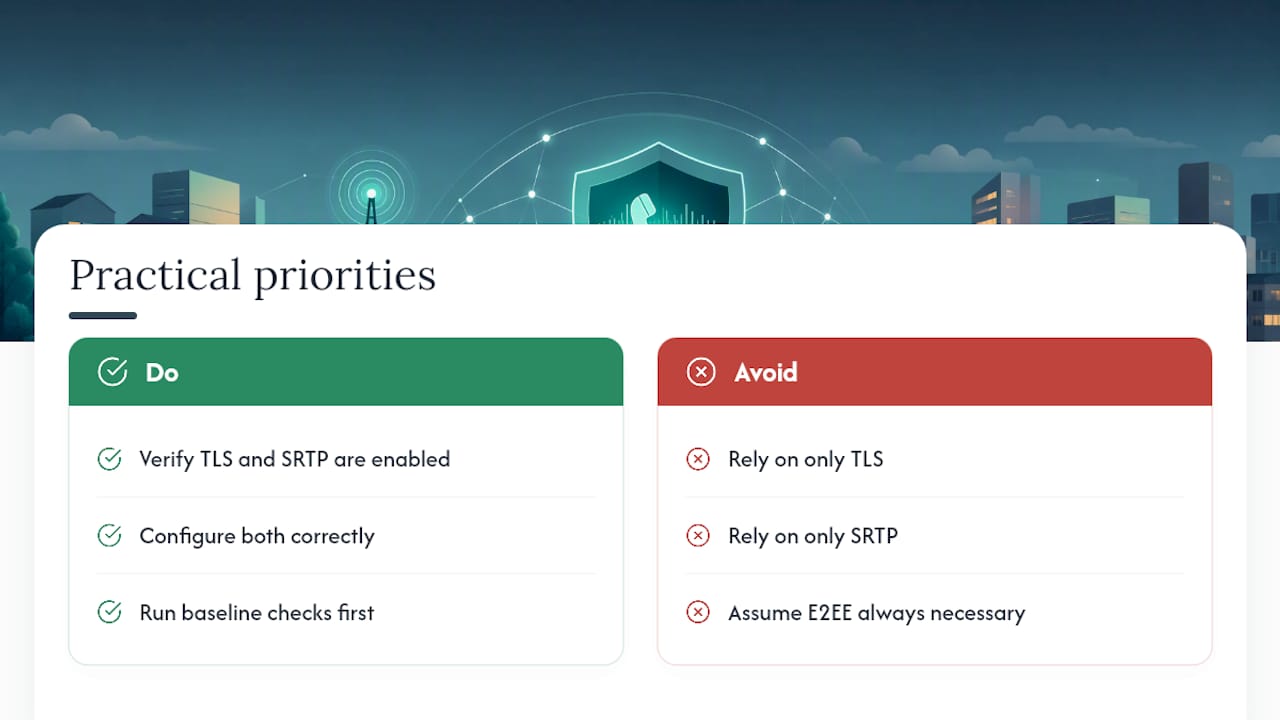
Most advice on VoIP privacy treats encryption like a light switch: on or off, done. That's not how it works in practice, and treating it that way is where most small businesses go wrong. TLS without SRTP, or SRTP without TLS, gives you the appearance of security while leaving half the conversation exposed. The research is unambiguous on this point, yet plenty of phone systems still ship with one layer configured and the other quietly skipped.
The conventional advice also oversells end-to-end encryption as a universal upgrade. It isn't. E2EE is the right call for a law firm handling privileged conversations, and the wrong call for a dispatch office that leans on call recording for quality control and dispute resolution. Prioritize verifying that TLS and SRTP are both live and correctly configured before you chase a fancier privacy feature. That single check catches more real-world exposure than any amount of provider shopping. Get the baseline right first, then decide if your situation genuinely calls for more.
— James
Sources
- Baseline cyber security controls for small and medium organizations — Canadian Centre for Cyber Security
- RFC 8862 — SIP Best-practice Recommendations Against Network Dangers to privacy (SIPBRANDY)
- Secure calling | PortaOne Documentation
- VoIP VPN: Secure your calls with encrypted voice protection — ExpressVPN
- SIP TLS & SRTP Guide: Encrypt VoIP Calls (IPComms)