
Most Canadian businesses now pay per minute rates for metered long-distance that are typically a few cents, or nothing at all under an unlimited Canada/US calling plan bundled into a VoIP or SIP trunk package. Before signing anything, get itemized, site-by-site quotes and a network and E911 readiness check. One Ontario option installs on-site and includes unlimited Canada calling in its service.
TL;DR:
- Per-minute long-distance rates in Canada typically range from 4 to 5 cents, with some plans including unlimited Canada/US calling bundled into the monthly fee.
- "Unlimited" plans often exclude mobile numbers, premium lines, or calls outside the defined destinations, so detailed plan wording is essential before committing.
- Ask vendors for transparent, itemized quotes that specify rates, charges, and scope for each site, along with a network and E911 readiness check.
- Cost savings for multi-site organizations come mainly from restructuring call routing, pooling minutes, and using internal networks, rather than just lower per-minute rates.
- On-site installation, fixed pricing, and warranties provide more reliable cost control than relying solely on per-minute rates, especially at multiple locations.
Table of Contents
- What Determines What You Pay for Long-Distance in Canada
- Common Per-Minute Rates and Unlimited Plan Offers in Canada
- How to Compare Long-Distance Offers and What to Require in a Quote
- Cost-Saving Strategies for Multi-Site Operations
- Implementation and Hidden Costs: An On-Site Checklist
- How Multi-Site Canadian Businesses Have Cut Long-Distance Costs
- What Ontario Multi-Site Buyers Should Prioritize
- How BusinessVoip.ca Supports Ontario Multi-Site Rollouts
- Sources
- FAQ
What Determines What You Pay for Long-Distance in Canada
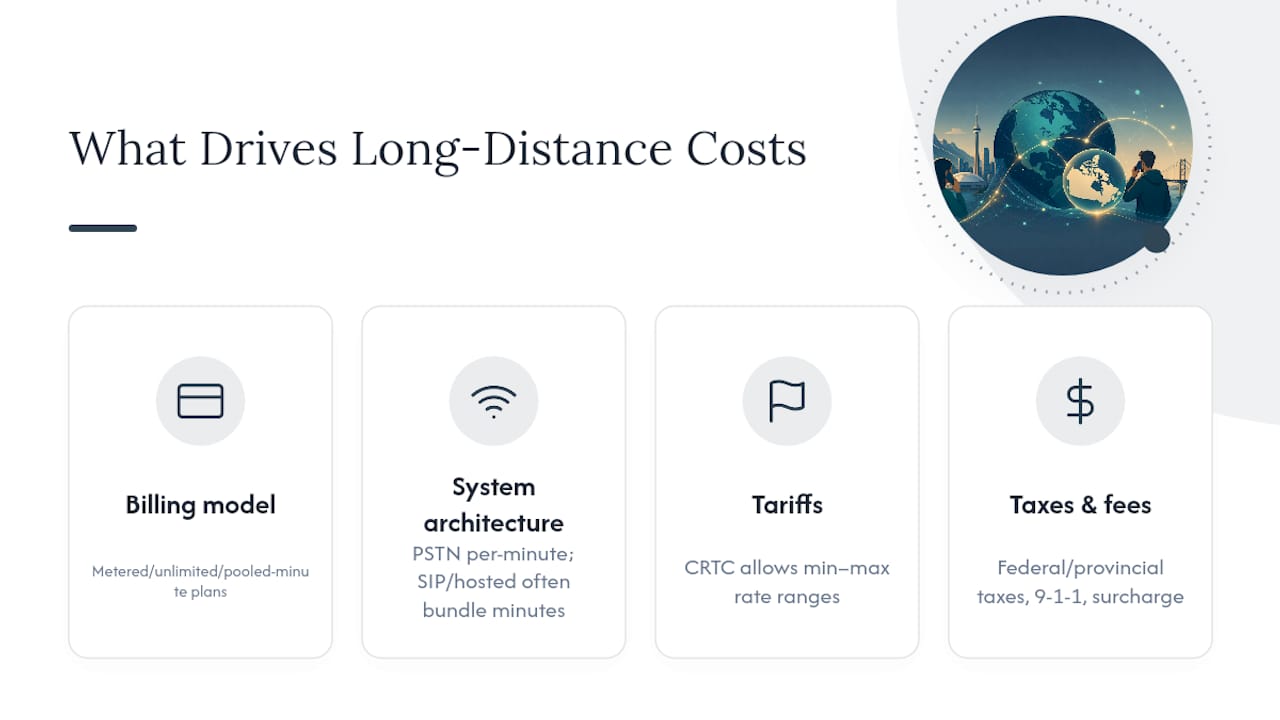
Three things drive your actual bill: the billing model, the system architecture, and the routing type of every call you place. Get these confused and a quote that looks cheap on paper turns expensive fast.
Metered per-minute plans charge for every long-distance minute, unlimited bundles fold Canada and U.S. calling into a flat fee, and pooled-minute plans split a shared allowance across multiple lines or sites. The wording matters more than the number. A provider advertising "unlimited long distance" might mean unlimited to Canadian and U.S. landlines only, with mobile or specialty numbers billed separately.
System architecture changes the math too. A traditional PSTN line bills long-distance the old way, per minute, per call. A SIP trunk or hosted PBX often bundles Canada/US minutes into the base rate, because the carrier is routing calls over IP rather than the legacy telephone network. That is why two businesses with the same call volume can get wildly different invoices depending on whether they run copper lines or a cloud PBX.
Canadian carriers operate under tariffs approved by the CRTC, and Telecom Order CRTC 2007-109 shows the regulator allows carriers to file minimum and maximum rate ranges for business voice services rather than one fixed number. That is why two quotes from the same carrier's own tariff can differ, and why toll-free numbers, premium lines, and mobile termination often carry separate rates from ordinary landline-to-landline calls. Expect federal and provincial taxes, a 9-1-1 fee, and sometimes a regulatory recovery surcharge, on top of the base rate.
Common Per-Minute Rates and Unlimited Plan Offers in Canada
Real carrier pricing gives you a sanity check against any vendor's quote. Videotron's business support page lists basic landline long-distance to Canada and the U.S. at about 4 cents per minute, while its cloud communications products include free Canada/US calling in the plan itself. SaskTel's Business One Rate advertises a flat $0.05 per minute for Canada or U.S. calls under its plan structure. Those two numbers, 4 cents and 5 cents, are a reasonable band to hold any per-minute quote against.
Unlimited claims deserve more scrutiny than the price itself. Shaw Business explains that included long-distance calling commonly excludes mobile numbers or specialty lines, and that unlimited features vary by plan and eligibility. Read the fine print before you assume "unlimited" means every call, everywhere, at no extra charge.
Here is how wording changes the actual cost:
- "Unlimited Canada" often means Canadian landlines and mobiles, but not the U.S.
- "Unlimited Canada and U.S." usually excludes premium, directory assistance, and some international-prefix numbers.
- "Unlimited within our network" can mean calls between your own sites are free, but outbound calls to other carriers are metered.
- "Business One Rate" style plans charge a flat per-minute rate with no bundled minutes at all, which suits low-volume callers better than high-volume call centers.
The safest approach: ask the vendor to write out, in plain language, exactly which destinations are included and which are billed separately.
How to Compare Long-Distance Offers and What to Require in a Quote
A quote that hides its true cost usually hides it in the line items nobody asked to see separated out. Insist on transparency before you compare a single number against another.
- Require the vendor to break out recurring monthly fees, per-minute rates by destination type (landline, mobile, toll-free), and one-time implementation charges as separate line items.
- Ask for a site-by-site implementation plan covering number porting, cabling, and a network and E911 readiness check for every location, not just headquarters.
- Get a written definition of "unlimited," including any fair-use cap, and confirm how international minutes outside Canada and the U.S. get billed.
- Negotiate fixed pricing for the contract term and a written warranty or replacement clause for any rented phones.
- Ask the vendor to name and link the specific tariff or rate reference behind their pricing, and verify it against the carrier's own published tariff pages.
Pro Tip: When a carrier cites a tariff range instead of a flat number, ask for the current operative price point and its effective date. A vendor that will not name a specific rate inside its own tariff is usually leaving room to bill you at the higher end of that range.
Multi-site organizations should also request a system design service as part of the quote, since design and porting decisions made at headquarters often determine costs at every branch office.
Cost-Saving Strategies for Multi-Site Operations
Unlimited Canada/US plans tend to beat metered rates once a multi-site business crosses a certain call volume, particularly for organizations where staff regularly call between branches or reach clients across provinces. Below that volume threshold, a flat per-minute plan like SaskTel's Business One Rate can actually cost less overall.
A few tactics consistently lower total spend without hurting call quality:
- Route calls between your own locations over SIP trunking or an internal network path so site-to-site calls never touch the public long-distance network.
- Pool minutes across all your locations under one account instead of buying separate allowances per branch, which avoids paying twice for unused capacity at a quiet location.
- Use toll-free forwarding for customer-facing lines and direct extension routing for internal traffic, so customer calls and staff calls are billed and tracked differently.
- Set call restrictions on lines that do not need international access, which prevents toll fraud and the unexpected charges that come with a compromised extension.
None of this requires exotic technology. It requires someone at the vendor level actually configuring the routing correctly at each site, which brings up the part most rate comparisons skip entirely.
Implementation and Hidden Costs: An On-Site Checklist
Per-minute rates get all the attention, but the bigger financial risk in a multi-site rollout is usually implementation, not billing. A site that is not cabled correctly or a number that gets stuck mid-port costs far more in downtime than a one-cent-per-minute rate difference ever will.
Before signing, confirm these get quoted per location, not as a single lump estimate for the whole company:
- Cabling, Power over Ethernet capacity, and switch readiness at each site, since older buildings often need upgrades before phones will even power on.
- Number porting status for every line, especially where porting crosses carrier territories, which can add delays compared to an in-territory port.
- Configuration, call routing setup, staff training, and testing time, all itemized rather than bundled into a vague "installation fee."
- A formal deployment milestone and acceptance test for each site, so nothing is marked complete until phones actually work on launch day.
Pro Tip: Ask for a written deployment schedule with a specific acceptance test date for every site. A vendor without one is planning to figure out your rollout as they go, on your dime.
Number porting across carrier territories is where multi-site projects most often stall. It is worth reading up on how porting actually works in Canada before you commit to a switch date for any location.
How Multi-Site Canadian Businesses Have Cut Long-Distance Costs
A property management company running five offices across southern Ontario is a common example of the pattern. Each site used to run its own landline account, billed separately, with staff routinely calling between locations for maintenance coordination and tenant issues. Consolidating those accounts under one hosted PBX with pooled Canada/US calling eliminated the inter-office metered charges entirely, since site-to-site traffic moved onto the provider's own network instead of the public long-distance grid.
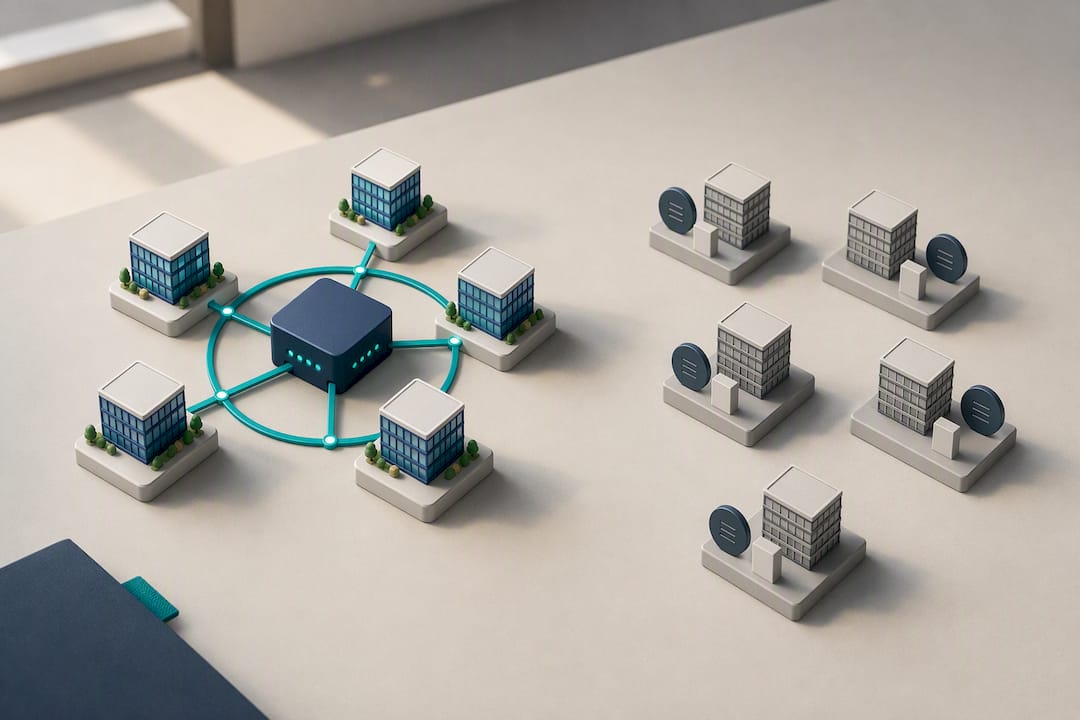
A regional staffing agency with branches in three cities took a different route. Rather than switching everything at once, it moved locations one at a time, porting numbers in territory order and running an acceptance test at each branch before moving to the next. That staggered approach avoided the common failure mode of a simultaneous multi-site cutover, where one delayed port stalls the whole rollout.
The pattern across both cases is the same: the savings came less from shaving a cent off the per-minute rate and more from restructuring how sites talk to each other and to the outside world. A cloud PBX architecture that treats every branch as part of one network, rather than five separate phone bills, is usually where the real cost reduction happens for organizations with more than two or three locations.
What Ontario Multi-Site Buyers Should Prioritize
The rate you get quoted matters less than whether the system actually works on day one at every location. A half-cent difference in per-minute pricing disappears fast against the cost of a stalled port or a site that goes dark because nobody checked the network beforehand.
Ontario businesses running multiple sites tend to come out ahead with a vendor that handles on-site installation, commits to fixed pricing, and backs rented phones with a warranty. The immediate move: request itemized, site-by-site quotes and schedule a network and E911 check before you sign anything.
— James
How BusinessVoip.ca Supports Ontario Multi-Site Rollouts
One option for Ontario businesses desiring predictable costs offers system design, programming, cabling, and on-site phone system installation at every location, avoiding the need to configure hardware yourself.
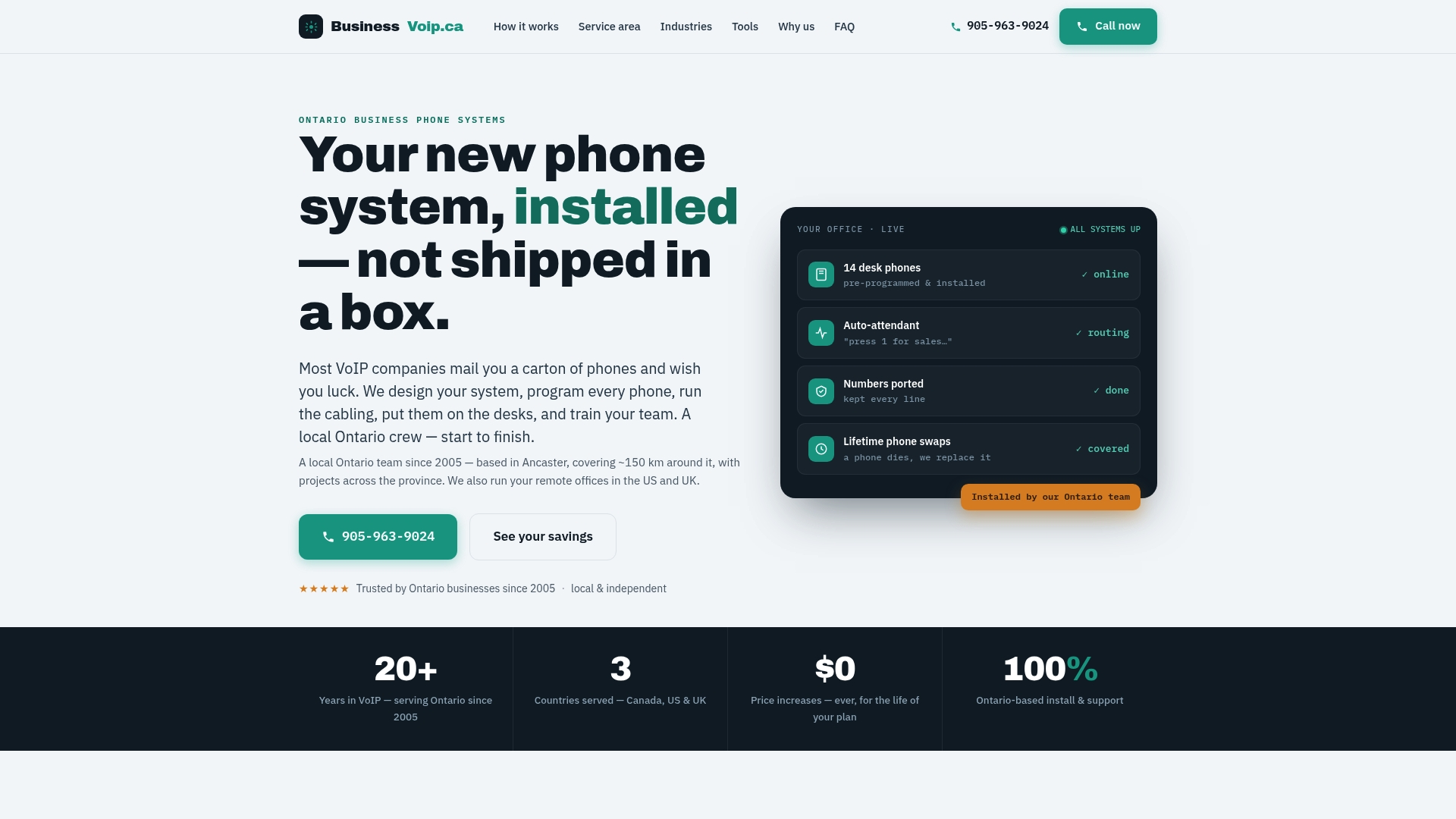
Fixed pricing means no annual rate increases eating into the savings you negotiated on day one, and some providers offer phones with a lifetime warranty. That combination suits organizations with several branches best, since predictable per-site costs matter more than a marginal per-minute difference once you are managing multiple locations. The company's multi-site and remote office support covers exactly the kind of rollout this article has walked through: unlimited Canada calling, remote office integration, and a network check before anyone signs off on the installation.
If your organization operates within about 150 km of Ancaster, or you have a larger provincewide project in mind, start by requesting an itemized, site-by-site quote and a network and E911 readiness check before your next contract renewal date.
Sources
- Telecom Order CRTC 2007-109
- Long-distance calls rates | Support Videotron Business
- Business One Rate | Business | SaskTel
- Business long distance use and account protection | Shaw Business
FAQ
What Is a Typical Long-Distance Rate for Canadian Businesses?
Metered plans commonly run between about 4 cents per minute, as shown on Videotron's business rate page, and 5 cents per minute under SaskTel's Business One Rate. Many hosted PBX and SIP trunk plans bundle Canada/US calling into the monthly fee instead of billing per minute.
Does "Unlimited" Long Distance Really Mean Every Call Is Free?
Not always. Shaw Business notes that unlimited plans commonly exclude mobile numbers or specialty lines, so you need the exact plan wording before assuming full coverage.
Why Do Carrier Rates Vary Even Within the Same Company?
The CRTC allows carriers to file approved minimum and maximum rate ranges for business voice services rather than one fixed rate, so the actual price you get can sit anywhere in that approved range depending on your plan and location.
What Should a Multi-Site Business Ask for Before Switching Providers?
Request itemized quotes broken out by site, covering per-minute rates, one-time porting and cabling charges, and a network and E911 readiness check for each location. BusinessVoip.ca provides this kind of on-site system design as part of its installation process for Ontario businesses.
How Much Does BusinessVoip.ca Cost?
Pricing is fixed with no annual increases, but the exact rate depends on your site count and system needs, so current pricing is available directly on the Businessvoip site.