Yes, you can port your phone number to a new provider in Canada, and the process is straightforward when you know the rules. Local Number Portability (LNP) is a regulated right in Canada, overseen by the CRTC, managed operationally by the Canadian Local Number Portability Consortium (CLNPC), and administered through the NPAC system run by Neustar. Before you do anything else:
- Contact your new provider and tell them you want to keep your existing number.
- Do not cancel your old service. Keep it active until the port is complete.
- Gather a recent invoice, your account number or PIN, and your billing name and address.
Pro Tip: Never cancel your old account before the port finishes. A canceled number becomes ineligible for porting, and you could lose it permanently. The port request itself acts as your cancellation notice.
Key Takeaways
Number porting in Canada is a regulated right, and the port succeeds or fails almost entirely on preparation: keeping the old account active, matching account details exactly, and confirming E911 registration after the cutover.
| Point | Details |
|---|---|
| Keep old service active | Never cancel before the port completes; cancellation voids eligibility. |
| Gather exact account details | Account number, PIN, billing name, address, and a recent invoice must match carrier records precisely. |
| Timeline varies by type | Mobile ports often complete in hours; business and VoIP lines may take several business days. |
| Confirm E911 after porting | Emergency-service routing is not automatically updated; verify your civic address with the new provider. |
| Businessvoip manages the process | Businessvoip handles porting, PBX programming, and E911 verification on-site for Ontario businesses. |
Table of Contents
- What is number porting in Canada and who manages it?
- Which phone numbers can and cannot be ported in Canada
- Step-by-step checklist to port your phone number in Canada
- How long number porting takes in Canada and what fees to expect
- Porting considerations for businesses: PBX, DID ranges, and hosted VoIP
- Common reasons ports are rejected or delayed and practical fixes
- Essential questions to ask your new provider before you start a port
- What porting numbers for Ontario businesses has taught us
- Businessvoip handles number porting and full system migrations for Ontario businesses
- Sources
What is number porting in Canada and who manages it?
Number porting, formally called Local Number Portability (LNP), lets you move an active phone number from one Canadian carrier to another without changing the digits. The CRTC sets the policy framework that makes this a consumer right. Three organizations keep the system running:
- CRTC (Canadian Radio-television and Telecommunications Commission): the federal regulator that mandates number portability and sets the rules carriers must follow.
- CLNPC (Canadian Local Number Portability Consortium): the industry consortium that manages LNP policy, governs member access to the NPAC system, and coordinates strategic planning for Canadian number portability.
- NPAC (Number Portability Administration Centre): the industry administration center operated by Neustar that mediates port notifications and distributes network routing data when numbers move between providers.
Technically, LNP works through a Location Routing Number (LRN). When your number ports, the NPAC SMS system updates the routing database so calls to your old number reach your new provider's network instead. Canada currently implements service-provider portability, meaning you can switch carriers and keep your number. Geographic portability (moving a number to a different calling area) is defined conceptually but not currently available.
Which phone numbers can and cannot be ported in Canada
Not every number qualifies. The Canadian Telecommunications Association is clear: only active phone numbers are eligible for porting. If your number is suspended, terminated, or deactivated, the port will be rejected.
Numbers that can typically be ported:
- Active wireless numbers (within the same local calling area)
- Active wireline numbers moving to a wireless provider, and vice versa
- Active VoIP numbers assigned to a Canadian rate center
- Prepaid numbers, provided the account is still active and in good standing
Numbers that cannot be ported:
- Suspended, canceled, or deactivated numbers
- Short codes and Special Service codes (e.g., 310-xxxx, 211, 511)
- Numbers tied to a service that has already been disconnected or reassigned
- Numbers outside the new provider's supported rate center or service area
Geographic and infrastructure limits matter too. A carrier can refuse a port if their network doesn't support the number's rate center. Always confirm with your prospective new provider before committing.
Pro Tip: If your number is on a prepaid plan that's been dormant for months, call your current provider first to confirm the account is still active. A dormant prepaid number can slip into a deactivated state without notice.
Step-by-step checklist to port your phone number in Canada
The Canada number transfer process follows a consistent sequence regardless of whether you're moving a cell phone, a landline, or a business line.
- Choose your new provider and confirm they can port your specific number and support your rate center.
- Tell them you want to keep your number at the time of signup. Do not assume this happens automatically.
- Keep your old service active. Do not cancel it. The port request serves as the cancellation notice once it completes.
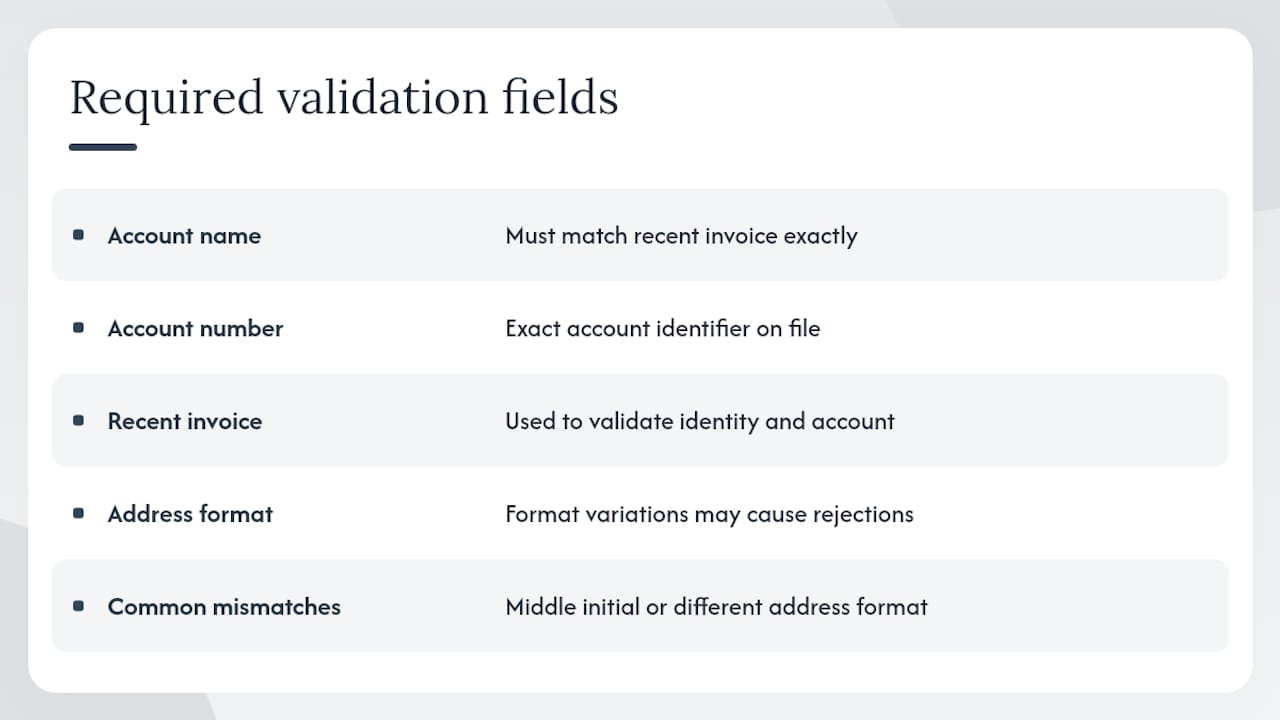
- Provide the required verification documents (see table below).
- Authorize the transfer by signing or electronically confirming the port request with your new provider.
- Respond to any validation messages. Mobile ports often trigger an SMS to your current number asking you to reply "YES" within a set window. Missing this window delays the port.
- Confirm activation with your new provider and test calls before considering the process done.
Required documents by service type
Providers typically validate your identity against recent invoice details and your account identifier. A mismatch on any field, even a middle initial or a slightly different address format, is one of the most common reasons a port gets rejected.
Pro Tip: For PBX and DID migrations, schedule the cutover during a low-traffic window, typically early morning or a weekend, and have a technician on-site to reprogram extensions and test inbound routing before staff arrive.
How long number porting takes in Canada and what fees to expect
Timelines vary by number type and provider. Here's what to expect:
- Mobile to mobile: Often completed within a few hours after validation, sometimes the same business day.
- Wireline to wireless (or wireless to wireline): Up to 2 business days after the port request is submitted and validated.
- Business lines, PBX, or VoIP: Timelines vary depending on the number of DIDs, coordination requirements, and whether a maintenance window is needed. Allow several business days and plan accordingly.
Variables that affect timing include: how quickly you respond to the SMS validation, whether your account details match exactly, outstanding balances on the old account, and the new provider's internal processing queue.
On fees: most Canadian carriers do not charge a porting fee, but early termination charges from your old provider may apply if you're mid-contract. Outstanding balances on the old account must be settled. The CRTC confirms that you don't need to give 30 days' notice to cancel when porting. The transfer request itself triggers the cancellation, which means you won't be double-billed if the timing is handled correctly. Don't cancel early trying to avoid a billing cycle. That's the move that costs you the number.
Porting considerations for businesses: PBX, DID ranges, and hosted VoIP
Business porting is a different animal from a consumer mobile port. A single office might have dozens of Direct Inward Dial (DID) numbers, SIP trunks, and an on-premises or hosted PBX that needs reprogramming. Getting this wrong means phones go silent during business hours.
- Audit all numbers and DIDs before you start. List every number in use, who owns each account, and which carrier holds it.
- Collect account details for each number. Each DID may be on a separate account or invoice. You'll need them all.
- Map extensions to new DIDs. Know which extension rings which DID before the port, not after.
- Order temporary numbers if needed. A temporary number lets calls roll in while the main numbers are in transit.
- Schedule a maintenance window. Coordinate with your new provider and your on-site IT team. Staged cutovers, where you port numbers in batches, reduce risk compared to moving everything at once.
- Test inbound and outbound calls on each ported number before the window closes.
- Confirm E911 location data. After a port, your emergency-service routing must be updated to reflect the correct civic address. This is not automatic. Verify it with your new provider before going live.
The NPAC SMS system updates LRN routing data when numbers move between switches, but your PBX dial plan and SIP trunk configuration need to be updated on your end. For multi-site operations, staged porting and parallel SIP trunks during the transition window are standard practice.
Pro Tip: Run a full test of inbound calls, outbound calls, and 911 dialing from at least one phone on each ported DID before you release the maintenance window. A routing error that goes undetected until Monday morning is far more disruptive than one caught at 7 AM on Saturday.

Common reasons ports are rejected or delayed and practical fixes
Most port failures come down to a small set of preventable problems.
Common rejection causes:
- Account details don't match exactly (name, address, account number, PIN)
- The number is suspended, deactivated, or has an unpaid balance
- Missing or expired PIN on the old account
- Missed SMS validation window on a mobile port
- New provider doesn't support the number's rate center
- The number was recently reassigned by the old carrier
Escalation steps when a port stalls:
- Ask your new provider for the specific rejection reason from the NPAC system.
- Correct the mismatched detail and resubmit. Even a small formatting difference in an address can cause a rejection.
- If the old provider is blocking or delaying the port without a valid reason, ask your new provider to escalate with NPAC.
- Request a written status update with an estimated completion date.
- If the port remains unresolved after reasonable attempts, file a complaint with the CRTC. The CRTC has authority to intervene when a carrier is not cooperating with a legitimate port request.
One often-overlooked issue: 911 service. After any port, especially a business or VoIP port, your E911 registration may not automatically follow the number. Confirm with your new provider that your civic address is correctly registered in the emergency-services database before you consider the port complete.
Essential questions to ask your new provider before you start a port
A five-minute conversation before you submit the port request can prevent a week of delays. Ask these directly:
- Can you port this specific number? Confirm they support the rate center and number type.
- Do you support the LRN for my number's current location? Relevant for business and VoIP lines.
- Will you submit the port request and handle the cancellation with my old provider? The answer should be yes. If they expect you to cancel separately, that's a red flag.
- What documents do you need from me? Get the exact list, not a general description.
- What is the expected timeline, and what's the fallback if it's rejected?
- Are there any fees, including early termination charges from my old provider?
Get written confirmation of the expected completion date and any fees before you sign anything. A verbal estimate is not a commitment.
What porting numbers for Ontario businesses has taught us
The paperwork problems are rarely the real issue. In practice, the ports that go sideways for Ontario businesses usually come down to one of three things: an account detail that doesn't match the carrier's records exactly, a DID that nobody realized was on a separate account, or a cutover that was scheduled without a technician available to reprogram the PBX on the spot.
The businesses that get through a migration cleanly are the ones that treat the audit phase seriously. Before a single port request goes in, every number is listed, every account is verified, and every extension is mapped. That groundwork takes a few hours. Skipping it can cost days.
For multi-line migrations, parallel service during the cutover window is worth the short-term cost of running two systems simultaneously. It gives you a real fallback if a number doesn't port on schedule, and it means staff can keep working while the transition finishes in the background. The staged approach, porting numbers in batches rather than all at once, is standard practice for a reason.
Businessvoip handles number porting and full system migrations for Ontario businesses
Ontario businesses switching to a VoIP phone system don't have to manage the porting process alone. Businessvoip designs, programs, cables, and installs your phone system on-site, and number porting is part of that service, not an afterthought.
The Businessvoip team handles the full migration: auditing your existing numbers and DIDs, coordinating the port requests, programming your PBX, verifying E911 location data, and testing every line before the cutover window closes. For businesses with multiple offices or remote locations, staged cutovers and parallel service during the transition are standard. Fixed pricing means no surprise fees, and rented phones carry a lifetime warranty. Businessvoip serves businesses within roughly 150 km of Ancaster and takes on larger projects province-wide. To get a system designed around your numbers and your timeline, start with a phone system design.
Sources
These are the primary resources for Canadian number porting policy, administration, and carrier-specific processes:
- Switch providers and keep your number | CRTC
- LNP FAQs / Public Knowledgebase / NPAC
- The Canadian NPAC
- CLNPC - Canadian Local Number Portability Consortium
- Wireless number portability – Canadian Telecommunications Association