
The best setup for multi-location, cross-border offices is a centrally managed cloud PBX paired with regional SIP trunks and local DIDs in each country, installed and validated by an on-site partner rather than a self-service portal. That combination gives you one admin panel, local caller ID everywhere you operate, and confirmed E911 routing before anyone's phone goes live. The immediate next step is booking a network readiness and E911 verification check, not picking a plan, and hoping the phones work.
TL;DR:
- Ensuring local DIDs and caller ID for each office are properly provisioned is essential to prevent hesitation or dropped calls from clients.
- A managed, on-site installation paired with validation of network readiness and E911 routing reduces the risk of call failure and emergency dispatch issues across borders.
- Staged rollout with thorough testing of porting, call flow, and codec compatibility minimizes disruptions during multi-location migration.
- Proper network configuration, including disabling SIP ALG, opening necessary ports, and prioritizing voice traffic, is critical to maintaining call quality and avoiding issues.
Table of Contents
- What Cross-Border VoIP Offices Must Deliver
- How Multi-Location VoIP Architecture Actually Works
- How to Choose a Provider for Multi-Site, Cross-Border VoIP
- Migration and Cutover: What to Expect
- Network Readiness: The Technical Checklist
- What Cross-Border VoIP Actually Costs
- How We Deploy Multi-Site, Cross-Border VoIP
- When a Managed Partner Beats Self-Serve Cloud VoIP
- Get a Network and E911 Check Before You Commit to a Provider
- Sources
What Cross-Border VoIP Offices Must Deliver
A phone system that spans a Canadian head office and a satellite location in the US or UK has to solve problems a single-office setup never faces. Get any one of these wrong and you end up with dropped calls, blocked emergency dispatch, or a bill nobody can reconcile.
Local DIDs and native caller ID. Every office needs phone numbers that look local to the people calling it. A Boston client should see a Boston-area code when your US office calls back, not an Ontario number with a country code that makes them hesitate to pick up. Managed international telephony platforms handle this by provisioning local, national, mobile, and even toll-free DIDs across dozens of countries as part of one setup process, bundling the DID provisioning with SIP trunking and PBX integration so you are not stitching together three separate vendors to cover three offices.
SIP trunking versus hosted PBX, and why the distinction matters here. A SIP trunk is the pipe that carries your calls to the public phone network; the hosted PBX is the brain that decides what happens to a call once it arrives. Cross-border deployments typically need both: one shared PBX brain for consistency, and regional SIP trunks so voice traffic in each country routes through local carrier infrastructure instead of bouncing back to a single distant data center.
E911 obligations don't disappear because a call rides over the internet. In Canada, the CRTC has specific customer notification requirements for VoIP providers around 9-1-1 service, and any provider worth hiring should walk you through exactly how emergency calls get routed and how your registered address stays current for every extension, at every location. This isn't a box to check once; it needs revalidation every time someone moves desks or a new office opens.
Quality of service tracks back to physical distance and carrier relationships. Voice quality on a cross-border call depends on how many networks that call hops across before it reaches the other party. Providers with direct carrier connections, rather than resold capacity through three intermediaries, cut down on that hop count. A short list of what to confirm before signing anything:
- Local points of presence (PoPs) in or near each country you operate in, not just one PoP serving an entire continent
- Direct carrier peering agreements rather than reliance on third-party termination resellers
- Codec support for G.722 or Opus where bandwidth allows, falling back to G.711 only when necessary
- TLS encryption for signaling and SRTP for the actual voice media, on every trunk, not just the "premium" tier
- A written SLA with a specific uptime number, not a vague promise of "reliability"
Enterprise voice providers built for scale illustrate what good coverage looks like: Sinch reports direct connections in more than 60 countries and local number availability in more than 70 markets, backed by a 99.95% uptime SLA. That's the kind of infrastructure depth you want your provider either operating directly or connected to.
How Multi-Location VoIP Architecture Actually Works
Most successful cross-border deployments follow a hub-and-spoke pattern: one central platform manages the whole organization, while each office keeps its own dial plan, local numbers, and business hours. Think of the hub as headquarters setting the rules, and each spoke as a branch that still gets to answer the phone in its own accent.
Centralized management, local identity. The head office (or IT team) controls user provisioning, call recording policy, and reporting from a single dashboard. Meanwhile, the Vancouver office rings differently than the London one, holidays route correctly for each jurisdiction, and after-hours voicemail greets callers in the right time zone. Multi-location phone platforms are built specifically to centralize administration while preserving that per-location identity, which is the whole point of choosing one system instead of stapling together separate contracts.
Call queues, presence, and transfers that cross location lines. A well-built system lets a call ring simultaneously at a Toronto desk and a rep's mobile app, and if nobody picks up, overflow to a colleague at another office entirely. Presence indicators (available, on a call, away) sync across locations too, so a receptionist in Cambridge can see that the Guelph sales rep just picked up another line before transferring a customer.
The patchwork trap. Plenty of growing companies end up with a Frankenstein setup: legacy PBX at headquarters, a consumer VoIP app at the satellite office, and a separate toll-free line handled by yet another vendor. It works, technically, until someone needs a report across all three, or a customer gets bounced between systems that don't talk to each other. AVOXI's research on multi-office communications points out that single-platform approaches simplify billing, administration, and reporting precisely because they eliminate that fragmentation, though they require some upfront standardization of dial plans and extension numbering to keep per-location customization from becoming its own mess.
A phased rollout keeps that standardization from turning into a fire drill:
- Discovery and documentation. Map every current number, extension, and call flow at each office before touching anything.
- Pilot at one location. Choose the smallest or least disruption-sensitive office to run the new system first.
- Validate E911 and porting at the pilot site before scaling to a second location.
- Staged rollout to remaining offices, one or two at a time, never all at once.
- Parallel run with rollback points. Keep the old system live in listen-only mode for a defined window in case something breaks.
- Full cutover and decommission of legacy lines only after every location has confirmed clean call flow for at least a week.
How to Choose a Provider for Multi-Site, Cross-Border VoIP
The provider you pick determines whether your rollout is smooth or a six-month headache. Ask the wrong questions upfront and you find out the hard way, usually during a client call that drops mid-sentence.
Start with the non-negotiables:
- In-country DIDs with confirmed local routing — not just a number that looks local while the underlying call actually routes through a third country
- Documented E911 handling per location, including how address updates get pushed to the emergency database when someone relocates
- On-site installation capability, or at minimum a clearly defined process for cabling, phone programming, and network validation before go-live
- A real SLA with a support model that specifies response times, not just "we're available"
- Direct carrier relationships rather than reselling capacity through layers of intermediaries, since providers with their own network infrastructure and multiple points of presence tend to produce lower added latency than those routing through resold trunks
On the commercial side, get specific about pricing structure before comparing any two proposals. Is it per-seat, per-line, or a flat site fee? Do you own your phone numbers if you switch providers later, or are they tied to the contract? Are phones rented or purchased outright, and what happens if a handset fails in year three? Onboarding and installation fees vary wildly between vendors, and some bury them in the fine print rather than the quote itself.
Security and compliance verification matters just as much, even though it gets skipped more often than it should. Confirm TLS and SRTP are standard on every trunk, not an upsell. Ask what data retention policies apply to call recordings, and whether those recordings are stored in Canada or offshore, since that affects your compliance posture depending on your industry.
Pro Tip: Ask every finalist vendor the exact same three questions: "What's your typical porting timeline for a number in [specific country]?" "Walk me through your cutover sequence for a three-location rollout." "What's your escalation path if a call fails at 2 a.m.?" The vendors who answer with specifics instead of marketing language are the ones who've actually done this before.
Migration and Cutover: What to Expect
Number porting is where most timelines go sideways, so plan around it rather than against it. Domestic Canadian ports typically move faster than international ones, and a US number can take longer still depending on the losing carrier's cooperation. Build in buffer time. A port that's quoted at five business days can stretch to two weeks if paperwork gets kicked back once.
A staged migration sequence protects you from a worst-case scenario where every phone in every office goes dark at once:
- Pilot phase at one office, with old and new systems running in parallel for a defined test window.
- Acceptance testing at the pilot site: confirm inbound calls, outbound caller ID, voicemail-to-email delivery, and call recording all function before declaring it a success.
- Staged rollout to the next office, incorporating any fixes discovered during the pilot.
- Final cutover only after every location has passed the same acceptance checklist.
- Legacy decommission, cancelling old lines only once porting confirmations are in hand for every number.
The testing checklist itself deserves its own attention before any cutover date gets locked in. Confirm the auto-attendant (IVR) routes correctly for each language or department, voicemail-to-email delivers without delay, the mobile app registers and rings simultaneously with the desk phone, and call recording and reporting capture data at every location, not just the pilot site.
Two pitfalls come up constantly. Codec mismatches between offices on different networks can cause one-way audio or garbled calls, usually fixed by standardizing codec settings across every location rather than letting each site's router pick its own default. And underestimating concurrent call capacity, particularly at a call center or support desk location, leads to busy signals during your first high-volume day. Size for peak concurrent calls, not average daily volume.
Network Readiness: The Technical Checklist
Before any provider touches your phones, your network has to be ready to carry the load, and that means doing the math instead of guessing.
Bandwidth planning starts with concurrent call count. A single G.711 call needs roughly 100 kbps in each direction including overhead. If your Kitchener office runs 15 concurrent calls at peak, budget for at least 1.5 Mbps dedicated to voice traffic, separate from whatever your office already uses for email and web browsing.
Router and firewall configuration trips up more deployments than any other single factor. SIP ALG (Application Layer Gateway), a feature built into many consumer and even some business routers, frequently corrupts SIP signaling instead of helping it. Disable it. Confirm your firewall allows the specific SIP and RTP port ranges your provider requires, and set Quality of Service (QoS) rules that prioritize voice packets over bulk downloads.
- Disable SIP ALG on every router and firewall in the path
- Open the SIP signaling port range and RTP media port range your provider specifies
- Configure QoS to tag and prioritize voice traffic (DSCP EF or AF41 marking)
- Confirm codec settings match across all locations to avoid transcoding delays
- Set static IP addressing or DHCP reservations for desk phones to simplify troubleshooting
MPLS, SD-WAN, or the public internet is a decision that depends on how much you're willing to spend versus how much control you need. MPLS gives guaranteed bandwidth and predictable latency but costs more and takes longer to provision across borders. SD-WAN offers a middle ground, intelligently routing voice traffic across whichever available path performs best in real time. Plenty of smaller cross-border deployments run successfully over standard business internet with proper QoS configuration, as long as the connection has enough headroom.
Monitor these numbers, not just "is the phone working." Mean Opinion Score (MOS) below 3.5 signals a call quality problem worth investigating. Jitter above 30 milliseconds starts introducing audible choppiness. Packet loss above 1% is where calls begin dropping words or cutting out entirely. Providers who run their own network infrastructure with multiple PoPs tend to keep added latency under 20 milliseconds on most routes, which gives you far more headroom against these thresholds than routing through a chain of resellers.
What Cross-Border VoIP Actually Costs
Multi-site, cross-border VoIP pricing has more moving parts than a single quote line usually reveals, and comparing two proposals fairly means breaking each one down into the same categories.
The core components split into four buckets: the monthly subscription or per-seat licensing fee, the SIP trunk or termination cost for actual call minutes, per-DID charges for each local number you provision, and hardware, whether you're renting handsets or buying them outright. A quote that only shows one number is hiding at least three of these.
Watch for costs that don't show up until after you've signed:
- Number porting fees, which some providers charge per number even when they're the ones gaining your business
- Add-on features like advanced call recording, analytics dashboards, or CRM integrations priced separately from the base plan
- Per-minute international termination rates, which can swing wildly between countries and matter enormously if your offices call each other frequently
- Installation or onboarding fees that get quoted separately from the ongoing subscription, sometimes as a surprise at contract signing
When comparing quotes across vendors, insist on the same unit basis: cost per seat per month, cost per DID, and cost per minute for both domestic and international termination. Build a simple 12 to 36 month total cost of ownership model that includes hardware amortization, since a "cheaper" monthly rate can lose to a competitor once you factor in a three-year phone rental versus an outright purchase with a shorter payback period.
How We Deploy Multi-Site, Cross-Border VoIP
Some providers design, program, cable, and install phone systems on-site rather than shipping a box of hardware and a login link. That distinction matters more in a cross-border deployment than almost anywhere else, because remote self-install is exactly where cutovers go wrong: a misconfigured router, a skipped E911 address update, a phone that never got its extension programmed correctly.
The project sequence follows a pattern any IT manager will recognize: discovery of current call flows and numbers, a network readiness assessment against the bandwidth and QoS benchmarks covered above, a pilot at one location, staged rollout to the remaining sites, and a support transition once every office has passed acceptance testing. Some phone rentals carry a lifetime warranty, and some vendors offer fixed pricing with no annual increases baked into the contract, which matters when building a multi-year cost model instead of guessing at renewal terms.
The real work in a cross-border rollout isn't picking a platform. It's making sure the network, the numbers, and the emergency routing are all validated at every single location before a single phone goes live.
What Businessvoip handles: system design, on-site cabling and installation, staff training, number porting coordination, network checks, and after-hours call routing setup, including for clients' remote offices in the US and UK. What the customer handles: site access for the installation team, a local point of contact at each office, and test numbers ready for acceptance testing during the pilot phase. That division of labor is what keeps a multi-location rollout from becoming a game of long-distance troubleshooting.
When a Managed Partner Beats Self-Serve Cloud VoIP
Self-serve cloud VoIP works fine for a single office with straightforward needs. Sign up, ship phones, configure over a web portal, done. Where that model breaks down is exactly where cross-border deployments live: multiple locations, regulatory obligations that differ by address, and a PSTN hybrid that still needs physical cabling and router configuration nobody in a remote office wants to attempt themselves.
The trade-off is real, and I don't think the industry talks about it honestly enough. Self-serve saves money upfront and moves fast for simple cases. But the moment you add a second country, an E911 obligation, or more than a couple of locations, the hours your own team spends troubleshooting SIP ALG settings and porting delays usually cost more than what you saved on the subscription. An on-site partner front-loads that complexity into the installation phase, where it belongs, instead of leaving it to surface during a client call three months in.
Cloud-only self-serve is still the right call for a single-location startup with no regulatory complexity and a technically confident staff member willing to own the setup. Everyone else running more than one office across a border should weight the decision toward a managed, on-site partner.
— James
Get a Network and E911 Check Before You Commit to a Provider
Most VoIP vendors will happily sell you a subscription over the phone without ever touching your network or verifying your emergency routing. Some providers have local teams that design, cable, and install systems on-site, backed by carrier-grade infrastructure that already carries tens of thousands of business calls a day.
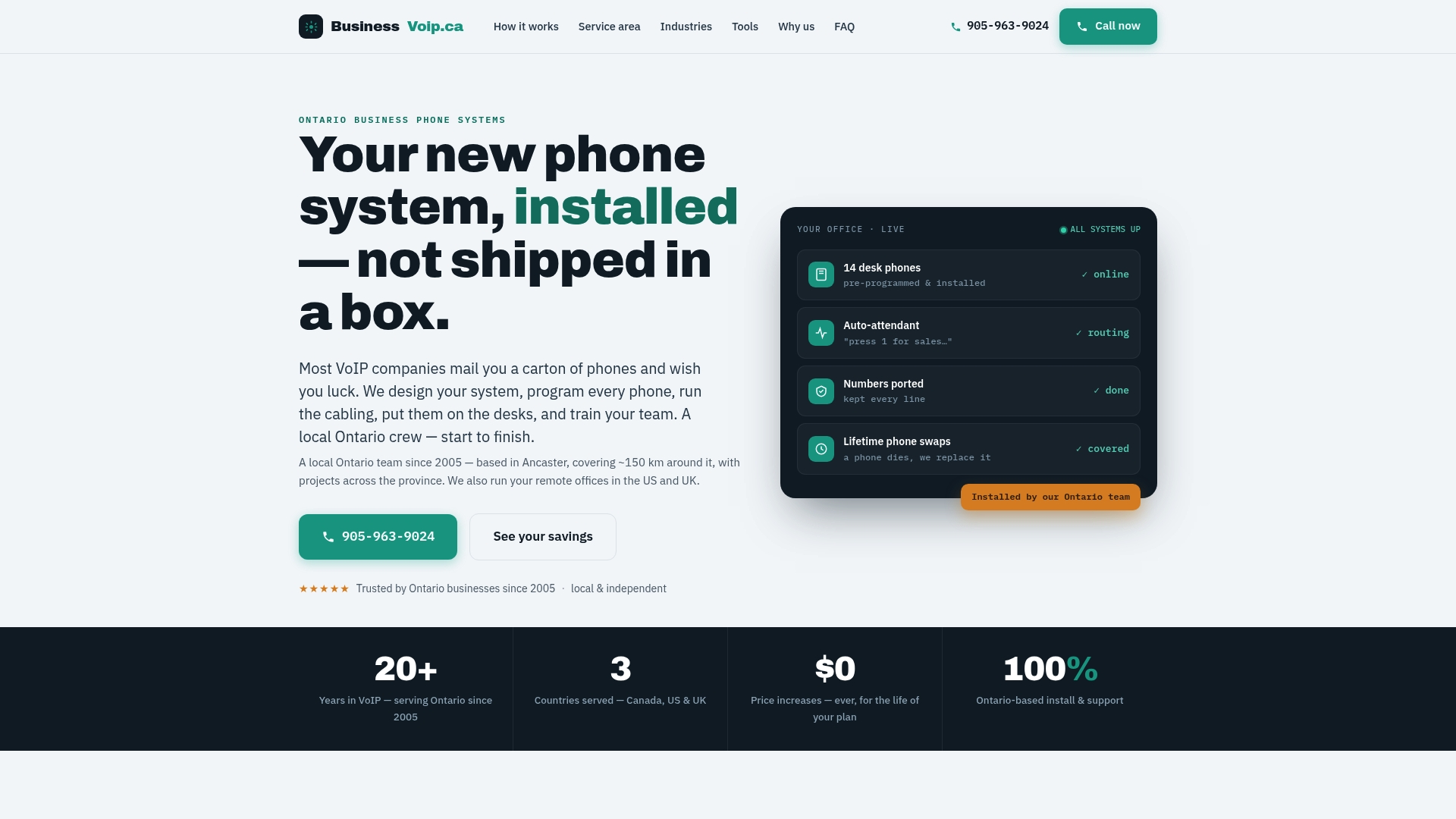
For companies running offices across borders, the multi-site and remote office VoIP page walks through exactly how that plays out for a head office in Ontario coordinating with satellite locations elsewhere, including clients' remote offices in the US and UK. Fixed pricing can mean no surprise increases at renewal, and some rented phones carry a lifetime warranty, which takes some hardware-cost guesswork out of a TCO model.
A typical discovery call covers your current locations, number counts, and any E911 or porting complexity specific to your setup, followed by a network readiness assessment before any commitment gets made. Businesses coordinating remote staffing across provinces should also check how the CRA's 2025 guidelines for remote workers might affect contractual arrangements tied to a multi-location rollout.
Request a network check and quote through the multi-site VoIP page to get a realistic timeline for your specific office count and locations.
Sources
For CRTC guidance on VoIP notification and 9-1-1 requirements, see the Government of Canada's official notice. For examples of international DID and SIP trunk coverage, review VoipTower's business telephony overview and Sinch's global voice capabilities. For Ontario-specific deployment detail, read Businessvoip's guides on E911 verification and VoIP calling across Canada.
- CRTC: customer notification requirements for VoIP and 9-1-1 (Government of Canada)
- Sinch Global Voice services
- didlogic SIP trunking overview