
In Canada, recording a phone call or in-person conversation is legal as long as you are a participant in that conversation. That is the core of Canada's one-party consent rule under Section 184(2)(a) of the Criminal Code. You do not need to tell the other person you are recording. What you cannot do is record a conversation you are not part of — that crosses into illegal wiretapping, punishable by imprisonment. This framework applies to telephone calls, in-person conversations, and digital communications across all provinces, including Ontario.
The distinction between criminal legality and civil liability is where most people get tripped up. Recording a call legally under the Criminal Code does not mean you can publish it, share it, or use it however you like. Civil courts can still hold you accountable for privacy violations, even when no criminal law was broken. Businesses face an additional layer: the Personal Information Protection and Electronic Documents Act (PIPEDA) imposes consent and disclosure obligations that go well beyond what the Criminal Code requires of individuals.
Here is a quick summary of the foundational rules:
- One-party consent applies nationwide: Any participant in a conversation may record it without notifying others.
- Non-participant recording is illegal: Intercepting a conversation you are not part of is a criminal offense under Section 184(1).
- Criminal legality ≠ civil immunity: A legally obtained recording can still expose you to a civil lawsuit.
- Businesses have stricter obligations: PIPEDA requires notification, stated purpose, and meaningful consent before recording customer calls.
- Quebec, British Columbia, and Alberta have provincial privacy laws that layer additional requirements on top of PIPEDA.
- Penalties for illegal interception include up to five years imprisonment under the Criminal Code.
Table of Contents
- How Ontario's recording rules apply to workplaces and private settings
- What businesses must do to comply with PIPEDA when recording calls
- Civil liability, privacy expectations, and when recordings can be used as evidence
- How video recording laws in Ontario differ from audio recording rules
- Best practices for Ontario businesses using call recording
- How to obtain valid consent for recording conversations
- What are the penalties for illegal call recording in Canada?
- When consent is not required: law enforcement and emergency exceptions
- Cross-border recording: what happens when calls cross provincial or national lines
- Businessvoip makes compliant call recording straightforward for Ontario businesses
- Key Takeaways
How Ontario's recording rules apply to workplaces and private settings
Ontario follows the federal one-party consent rule standard. If you are on the call or in the room, you can record it. That applies whether you are an employee recording a conversation with your manager, a landlord recording a tenant dispute, or a customer recording a call with a service provider.
Workplace recording is where things get more nuanced. Employees in Ontario have the legal right to record conversations they participate in, but exercising that right carries real professional risk. Recording a supervisor or coworker without their knowledge can damage trust, trigger disciplinary action, or complicate an employment dispute even when the recording itself is lawful. Courts and arbitrators have sometimes found that secret workplace recordings, while not criminal, reflect poorly on the employee who made them.
Ontario employers are also subject to employment standards requirements around electronic monitoring. Under the Employment Standards Act, 2000, employers with a qualifying number of staff must maintain a written electronic monitoring policy that discloses what is being monitored, how, and why. This does not prohibit recording, but it does require transparency about monitoring practices.
What is legal vs. illegal in Ontario workplaces:
- Legal: An employee recording a meeting they attend, to document a harassment complaint or disciplinary discussion.
- Legal: An employer recording calls handled by customer service staff, provided employees are notified through a written policy.
- Legal: Recording a conversation in a public setting where there is no reasonable expectation of privacy.
- Illegal: Placing a recording device in a room to capture conversations you are not part of.
- Illegal: Recording a private conversation between coworkers when you are not present.
- Risky but not criminal: Recording a coworker without their knowledge in a conversation you participate in — legal under the Criminal Code, but potentially harmful to your employment relationship.
The private vs. public setting distinction matters too. Recording someone in a coffee shop where others can overhear the conversation carries less legal risk than recording in a private office. Courts assess whether the person being recorded had a reasonable expectation of privacy in that context.
What businesses must do to comply with PIPEDA when recording calls
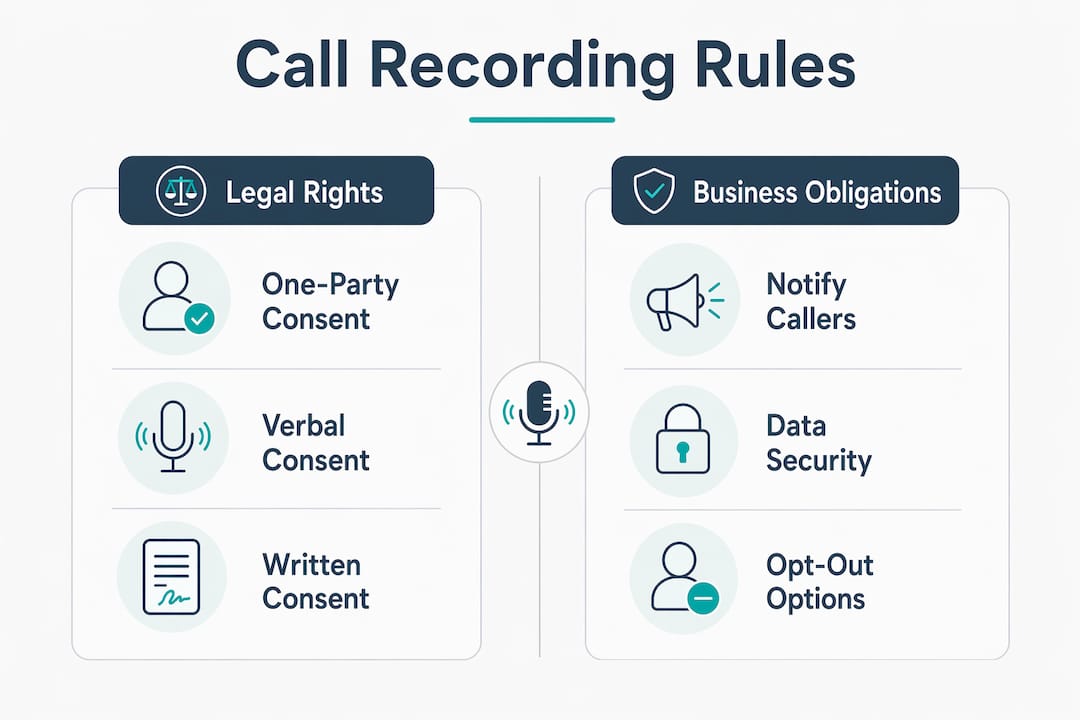
The Office of the Privacy Commissioner of Canada is direct on this: businesses recording customer calls must inform callers at the start of the call, state the purpose clearly, and give callers a meaningful way to opt out. Implied consent works — if a caller continues the conversation after being told it is being recorded and why, that counts as consent. But the notification has to come first, and the stated purpose has to be accurate.
That last point catches companies off guard. Telling a caller the recording is for "quality assurance" and then using it for sales training, legal evidence, or marketing analysis is a PIPEDA violation. The purpose you state is the purpose you are bound to. The OPC guidance is explicit: organizations must limit use and retention of recordings to the stated purpose.
Quebec, British Columbia, and Alberta each have provincial privacy legislation that applies to private-sector organizations operating within those provinces. Quebec's Law 25 (formerly Act Respecting the Protection of Personal Information in the Private Sector) is the strictest, requiring explicit consent in many cases where PIPEDA would accept implied consent. If your business records calls with customers in Quebec, you need to meet Quebec's standard, not just the federal one.
Key PIPEDA compliance requirements for businesses:
- Notify callers at the start of the call that recording will occur.
- State the specific purpose of the recording clearly and accurately.
- Offer a meaningful alternative if the caller objects (e.g., an in-person visit, written correspondence).
- Limit access to recordings to staff with a legitimate need.
- Retain recordings only as long as necessary for the stated purpose, then delete them securely.
- Document your consent procedures and keep records of your notification practices.
Recording for personal use generally falls outside PIPEDA's scope. The moment recording becomes commercial — customer service, sales, dispute resolution — statutory obligations apply.
Pro Tip: Draft your call recording notification as a single sentence that names the purpose and the opt-out option. "This call may be recorded for quality assurance and staff training. If you prefer not to be recorded, please let us know and we can assist you another way." Short, clear, and legally defensible.
Civil liability, privacy expectations, and when recordings can be used as evidence
The Criminal Code sets the floor, not the ceiling. Recording a call legally does not give you unlimited rights over what you do with it. Ontario recognized the tort of intrusion upon seclusion in Jones v. Tsige, and that precedent means a person can sue you for invading their privacy even when no criminal law was violated. The test is whether the intrusion was intentional, whether it involved private affairs, and whether a reasonable person would find it highly offensive.
Misusing a recording is the most common trigger for civil liability. Sharing a recorded conversation publicly, using it to embarrass someone, or disclosing it to a third party without consent can all support a civil claim. The fact that you were legally permitted to make the recording is irrelevant to whether you were permitted to distribute it.
Admissibility in court is a separate question. Canadian courts have discretion to exclude evidence that would bring the administration of justice into disrepute, even if the evidence was obtained lawfully. A recording made legally under one-party consent is generally admissible, but a judge can still weigh how it was obtained, whether it was edited, and whether its admission would be fair. Recordings that appear to be selectively edited or taken out of context face serious credibility challenges.
Key civil law considerations:
- A legally recorded conversation can still support a civil lawsuit if misused.
- Publishing or sharing a recording without consent may constitute defamation, breach of confidence, or intrusion upon seclusion.
- Ontario's intrusion upon seclusion tort does not require proof of financial loss — the invasion itself can be enough.
- Courts assess whether the person recorded had a reasonable expectation of privacy in that context.
- Lawyers in Ontario face an additional professional obligation: Law Society of Ontario Rule 7.2-3 requires lawyers to notify clients before recording, even when the Criminal Code would permit secret recording.
- Recordings used as evidence should be complete, unedited, and accompanied by clear documentation of when and how they were made.
How video recording laws in Ontario differ from audio recording rules
Video recording without audio is generally treated more permissively than audio recording in Ontario. The Criminal Code's interception provisions specifically target the capture of private communications, which means audio. A security camera that records video only, in a location where people have no reasonable expectation of privacy, typically does not engage the same criminal prohibitions.
The moment you add audio capture, the rules tighten considerably. Video surveillance with audio triggers the same interception provisions that apply to phone recording, because you are now capturing private communications. A workplace camera that records employee conversations without their knowledge is not just a privacy concern — it is potentially a criminal one.
Workplace video surveillance carries its own set of restrictions. Employers in Ontario can install cameras in common areas for legitimate security purposes, but surveillance in washrooms, change rooms, or other spaces where employees have a clear expectation of privacy is prohibited. The Ontario Human Rights Code and common law privacy principles both apply.
Key differences between audio and video recording in Ontario:
- Video only, public space: Generally permitted; no reasonable expectation of privacy applies.
- Video only, private space: Requires legitimate purpose; workplace surveillance must be disclosed.
- Video with audio, any setting: Triggers Criminal Code interception rules; one-party consent applies if you are present.
- Covert audio via surveillance device: Illegal if you are not a participant in the captured conversation.
- Disclosure requirement: Businesses using video surveillance must inform employees and, where PIPEDA applies, customers.
- Storage and access: Video recordings containing personal information are subject to PIPEDA's retention and access rules.
The practical takeaway for Ontario businesses: treat any recording system that captures audio as subject to the full suite of Criminal Code and PIPEDA requirements, regardless of whether it also captures video.
Best practices for Ontario businesses using call recording
Compliance is not just about what the law prohibits. It is about building a recording practice that holds up under scrutiny — from a regulator, a court, or an employee grievance. The OPC's guidance on limiting use and retention to stated purposes is a good starting point, but Ontario businesses need to go further.
Start with your notification. Every recorded call should begin with a clear, audible announcement that states the call is being recorded and why. This is not just a legal requirement under PIPEDA — it is your first line of defense if a recording is ever challenged. The announcement should be automatic, not dependent on a staff member remembering to mention it.
Data security matters as much as consent. Recordings contain personal information, and PIPEDA requires that personal information be protected against unauthorized access, disclosure, or loss. That means encrypted storage, restricted access controls, and a defined retention schedule. Recordings kept longer than necessary for their stated purpose are a liability, not an asset.

Unionized workplaces add another layer. Collective agreements often include provisions about monitoring and surveillance. Recording employee calls without addressing those provisions — even when the Criminal Code permits it — can trigger grievances and arbitration.
Businessvoip's VoIP phone systems for Ontario businesses are designed with these compliance realities in mind. Call recording is built into the system, with configurable notification prompts, secure storage, and the kind of on-site setup that means your team actually knows how to use it correctly from day one.
Compliance best practices for Ontario businesses:
- Automate your recording notification — do not rely on staff to announce it manually.
- Document your consent procedures and review them annually.
- Restrict access to recordings to staff with a clear, documented need.
- Set a retention schedule and enforce it; delete recordings when the retention period expires.
- Review collective agreements before implementing or expanding call recording.
- Train staff on what recordings can and cannot be used for.
Pro Tip: When designing your phone system, build the recording notification into the IVR (interactive voice response) flow rather than the individual call setup. That way, compliance is structural, not behavioral — it happens automatically, every time, regardless of which staff member answers.
How to obtain valid consent for recording conversations
Consent for recording comes in three forms in Canada: verbal, written, and implied. Each is legally valid under the right circumstances, but they carry different levels of evidentiary weight.
Verbal consent is the most straightforward for phone calls. A caller who says "yes, you can record this" on a recorded line has given clear, documented consent. The challenge is that verbal consent requires someone to ask for it explicitly, which adds friction to the call flow. Most businesses use implied consent instead.
Implied consent is what PIPEDA's framework is built around for commercial call recording. When a caller is told at the start of the call that the conversation is being recorded and they continue the call, their continued participation constitutes consent. This only works if the notification is clear, the purpose is accurately stated, and the caller has a genuine opt-out option. Passive notification buried in a terms-of-service document does not meet this standard.
Written consent is most relevant for in-person recording or situations where a recording will be used for a specific, sensitive purpose — a legal deposition, a formal complaint, a media interview. Written consent creates the clearest paper trail and is the hardest to dispute later.
For individuals recording personal conversations, the Criminal Code's one-party consent rule means no consent from the other party is required at all. The participant exception under Section 184(2)(a) is self-contained. You are a party to the conversation; you can record it. The consent question only becomes complex when you move into commercial use or when you plan to use the recording beyond its original context.
One practical note on digital platforms: tools like Zoom notify participants when recording starts, but that notification is a software feature, not a legal consent mechanism under Canadian law. One-party consent under the Criminal Code applies regardless of what the platform does or does not announce.
What are the penalties for illegal call recording in Canada?
The Criminal Code is not subtle about consequences. Intercepting a private communication without being a participant — illegal wiretapping — carries a maximum sentence of five years imprisonment. This is an indictable offense, meaning it is treated as a serious crime, not a minor infraction.
Beyond criminal penalties, civil consequences can be significant. Ontario's intrusion upon seclusion tort allows courts to award damages without requiring the plaintiff to prove financial loss. The invasion of privacy itself is the harm. Courts have awarded damages in cases where recordings were made covertly and then used to embarrass or harm the person recorded.
PIPEDA violations carry their own enforcement pathway. The Office of the Privacy Commissioner can investigate complaints, issue findings, and recommend corrective action. While the OPC cannot impose fines directly under PIPEDA, it can refer matters to Federal Court, which can order compliance and award damages. Quebec's Law 25 goes further, with the Commission d'accès à l'information empowered to impose administrative monetary penalties for serious violations.
Reputational damage is harder to quantify but often more immediately damaging than a fine. A business caught recording customers without proper consent, or an employer found to have covertly monitored employees, faces the kind of public scrutiny that affects client relationships and staff retention long after any legal proceeding concludes.
When consent is not required: law enforcement and emergency exceptions
The Criminal Code carves out specific exceptions to the consent requirement. Law enforcement agencies can intercept private communications without consent when they obtain a judicial authorization — a wiretap warrant. The threshold for obtaining one is high: police must demonstrate that other investigative methods have failed or are unlikely to succeed, and that the interception is necessary for a serious criminal investigation.
Emergency interception is a narrower exception. Police can intercept communications without prior judicial authorization in urgent situations where obtaining a warrant is not reasonably practicable, provided they apply for authorization as soon as possible afterward. This exception is tightly scoped and subject to judicial review.
Private citizens have no equivalent emergency exception. If you are not a participant in the conversation, you cannot record it — regardless of the circumstances. The participant exception under Section 184(2)(a) is the only avenue available to individuals, and it requires active participation, not just proximity. Leaving a recording device to capture a conversation you have stepped away from does not qualify as participant recording — that is illegal interception.
Certain regulated industries have sector-specific recording obligations that operate independently of consent. Financial institutions, for example, may be required by their regulators to record certain transactions. Those recordings are authorized by the applicable regulatory framework, not by individual consent. The same applies to some emergency dispatch operations, where recording is a standard operational requirement rather than a consent-based choice.
Cross-border recording: what happens when calls cross provincial or national lines
Canada's one-party consent rule applies to calls made within Canada, but the moment a call crosses into another jurisdiction, the legal picture gets complicated. The most common scenario for Ontario businesses is a call with a party in the United States.
The U.S. has a patchwork of state laws on top of federal wiretapping rules. Federal law in the U.S. follows a one-party consent standard, similar to Canada. But states like California, Florida, and Illinois require all-party consent — meaning every participant must know the call is being recorded. If your Ontario business records a call with a customer in California without notifying them, you may be complying with Canadian law and violating California law simultaneously.
The practical standard most legal advisors recommend for cross-border calls is to apply the stricter jurisdiction's rules. If you are calling into a two-party consent state or country, notify all parties. This approach protects you regardless of which jurisdiction's law applies, and it is consistent with PIPEDA's notification requirements anyway.
Interprovincial calls within Canada are simpler. The Criminal Code applies nationwide, so one-party consent governs regardless of which province each party is in. Quebec's stricter provincial privacy law applies to organizations operating in Quebec, but it does not change the criminal law standard for individuals. A business recording a call between its Ontario office and a Quebec customer must meet Quebec's privacy law requirements for consent and notification — but the recording itself is not criminal under the Criminal Code as long as a participant is making it.
For businesses with multi-site operations or remote offices in the U.S. or UK, the cross-border question is not hypothetical. Building a notification standard that satisfies the strictest applicable jurisdiction is the only approach that scales cleanly across locations.
Businessvoip makes compliant call recording straightforward for Ontario businesses
Ontario businesses that record calls are not just managing a feature — they are managing a legal obligation. Getting the notification right, storing recordings securely, and training staff on what recordings can be used for requires a phone system that is built for compliance, not just convenience.

Businessvoip installs fully configured VoIP phone systems on-site for Ontario businesses, with call recording built in from the start. The local team programs your recording notification directly into the call flow, so compliance is automatic rather than dependent on individual staff behavior. Recordings are stored securely, and the system is set up with the access controls and retention practices that PIPEDA requires. There are no annual price increases, rented phones carry a lifetime warranty, and the same team that installs your system supports it afterward. If you are running a multi-site operation or need to integrate remote offices, Businessvoip handles that too. To see how a properly configured system fits your business, design your phone system with Businessvoip today.
Key Takeaways
Canada's call recording laws permit any conversation participant to record without notifying others, but businesses face stricter PIPEDA obligations, and civil liability applies regardless of criminal legality.
| Point | Details |
|---|---|
| One-party consent is the federal standard | Any participant in a conversation may legally record it under Criminal Code Section 184(2)(a), with no obligation to notify others. |
| Non-participant recording is a criminal offense | Intercepting a conversation you are not part of carries a maximum sentence of five years imprisonment. |
| Businesses must notify and state purpose | PIPEDA requires callers to be informed at the start of the call, with the recording purpose accurately stated and an opt-out option offered. |
| Civil liability survives criminal legality | Ontario's intrusion upon seclusion tort means a legally obtained recording can still support a civil lawsuit if misused or shared without consent. |
| Businessvoip builds compliance into the system | Businessvoip programs call recording notifications into the phone system's call flow, so Ontario businesses meet PIPEDA requirements automatically from day one. |