Caller name display in Canada shows an incoming caller's registered name alongside their number, but that name comes from carrier databases and spam filters that don't always agree with each other. A registered business or personal name often fails to show up for every recipient, no matter which carrier you're on. If your name isn't appearing consistently, the fix usually isn't a single phone call to support. It means checking how your number is provisioned in the CNAM system and, for businesses, possibly moving to branded calling.
- Caller name display, sometimes called Caller ID or Caller Name Display, pulls from CNAM/LIDB or a cached alternative database
- One carrier registration doesn't guarantee display across Bell, Telus, Rogers, and Fido networks
- Spam and fraud filters can override or suppress a legitimate name
- Businesses with chronic "Unknown" or "Spam Likely" issues typically need branded calling, not just a CNAM update
Key Takeaways
Caller name display in Canada depends on which database a carrier queries and whether spam filters override that data, so a single registration rarely guarantees consistent results.
| Point | Details |
|---|---|
| CNAM isn't universal | Carriers may use full CNAM/LIDB lookups or cheaper cached databases, causing names to display inconsistently across networks. |
| Registration is a baseline, not a fix | A registered name can still get overridden by spam filters or fail to propagate to every carrier. |
| Blocking is simple, fixing display isn't | Dialing *67 blocks a name instantly, but changing your permanent display name requires carrier documentation and time. |
| Mobile and landline behave differently | Mobile display depends on VoLTE device compatibility and faces heavier spam filtering than legacy landline systems. |
| Businesses need active management | Businessvoip provisions and coordinates carrier-side caller name setup on-site for Ontario businesses, reducing repeated registration headaches across multiple lines. |
Table of Contents
- How Caller Name Display Actually Works in Canada
- How Do You Change or Block Your Caller Name Display?
- Why Branded Calling Beats Basic CNAM Registration
- Troubleshooting Caller Name Display Problems
- What Are the Privacy Rules Around Caller Name Display in Canada?
- Does Caller Name Display Work Differently on Landlines vs. Mobile?
- How Does CNAM Affect Call Blocking and Spam Filters?
- How Do Businesses Register a Caller Name With Canadian Carriers?
- Is Caller ID Spoofing Illegal in Canada?
- Sources
How Caller Name Display Actually Works in Canada
Every time your phone rings with a name attached instead of just a number, something on the network side queried a database and matched it to your line. That database is usually CNAM (Caller ID Name), which draws from LIDB (Line Information Database), the shared industry directory telephone companies use to look up subscriber names. It sounds like a simple lookup. In practice, it's inconsistent because not every carrier queries the same source the same way.
Here's the mechanical breakdown:
- CNAM/LIDB queries cost money per lookup, so some carriers and VoIP providers query it fully, while others rely on cached or third-party name databases to cut costs, as Digital Conceptions explains in its breakdown of Canadian caller ID name services.
- VoIP lines are more prone to inconsistency because many VoIP providers use these cached or alternate sources rather than paying for live CNAM queries every time, which is why a name can show correctly on one carrier and appear blank on another.
- Spam and fraud filters can override the name entirely, replacing it with "Scam Likely," "Spam Risk," or nothing at all, regardless of what's registered.
- Forwarded and international calls often lose the name entirely because the forwarding leg or the originating international carrier may not pass CNAM data along the chain.
Propagation isn't instant, either. A name change submitted to one carrier can take anywhere from a few days to a couple of weeks to show up, and it may never propagate to networks that use a different name source altogether.
Hiya reports that a large majority of Canadian consumers ignore calls from numbers they don't recognize, which is exactly why inconsistent name display isn't a cosmetic annoyance for businesses. It's a direct hit to answer rates.
How Do You Change or Block Your Caller Name Display?
Whether you're an individual tired of showing up as "Unknown" or a business trying to fix a display problem, the levers you have depend on whether you are changing behavior per call or updating your account permanently.
Per-call blocking is the simplest option. Dialing *67 before a number in Canada blocks your outgoing caller ID for that single call, and the recipient typically sees "Private" or "Blocked" instead of your number or name. Vonage's support documentation confirms this is standard behavior across most Canadian carriers and VoIP services, though the exact wording shown varies by device and carrier.
To permanently change your outbound display name, you generally need to contact your carrier directly. Consumer accounts can usually update the name tied to a mobile number through customer support, but business lines often require more:
- Your phone number(s) in full, including area code
- The exact display name you want shown, spelled precisely
- Proof of business registration or account ownership
- Confirmation that Call Display is included on your plan
After making changes, test calls from a different network. Update your device OS and refresh your contacts list, since a name might be cached locally even after the network-side change takes effect.
Pro Tip: Call your own business line from a personal cell phone on a different carrier after any change. That cross-network test catches propagation gaps that a single self-call never reveals.
Why Branded Calling Beats Basic CNAM Registration
CNAM registration is the baseline, not the finish line. It tells one database what your name should be, but it doesn't guarantee every carrier displays it, and it does nothing to stop a spam filter from mislabeling your number a month later. That's the gap branded calling is built to close.
Branded calling providers like Hiya work directly with carriers to white-list verified business numbers, pushing a consistent name (and sometimes a logo or reason for calling) across multiple networks at once, rather than hoping each carrier's own database picks it up. The stronger providers also run ongoing call inspections, checking how a number displays across major Canadian carriers and flagging when a network suppresses or alters it.
Registering a business name with a carrier is a starting point, not a guarantee. Carriers may not propagate that name to every network without additional white-listing, which is exactly why call inspections and monitoring matter more than a one-time registration.
Reputation management is the ongoing piece most businesses skip. A number can get flagged as spam because of call volume patterns, complaint reports, or shared infrastructure with a bad actor, and once flagged, fixing it takes active remediation, not a single form.
This is where coordination matters. Businessvoip designs and provisions on-site VoIP systems for Ontario businesses, which includes handling the carrier-side setup that determines whether your outbound name shows correctly in the first place. If your business depends on customers actually answering the phone, the choice isn't CNAM versus branded calling. It's whether you self-manage that relationship or hand it to someone who already has it.
Troubleshooting Caller Name Display Problems
Most display issues follow a predictable pattern, so work through this order before escalating to support:
- Verify provisioning first. Confirm the name was actually submitted and accepted by your carrier, not just requested. Ask for written confirmation.
- Test across at least three carriers. Call from lines on Bell, Telus, and Rogers/Fido networks and note exactly what displays on each.
- Check forwarded and international calls separately. These often behave differently than direct domestic calls, and a failure here doesn't necessarily mean your core setup is broken.
- Watch for truncation. Some services cap display names at a limited character count, similar to the length limits Vonage documents for its own caller ID service, so a long business name might get cut off mid-word.
- Escalate with evidence. Bring your carrier or vendor the specific numbers you tested, the dates, and screenshots of what displayed. Vague reports ("it's not working") get slower responses than documented ones.
A proper call inspection report, run across multiple networks on the same day, tells you definitively whether the problem is provisioning, propagation delay, or a spam flag.
What Are the Privacy Rules Around Caller Name Display in Canada?
Caller name display touches privacy law because it exposes personal or business identity information every time a call connects, whether the recipient wants it or not. In Canada, the Personal Information Protection and Electronic Documents Act (PIPEDA) governs how organizations collect, use, and disclose personal information, including phone numbers and names tied to CNAM records.
Carriers generally treat the name tied to your line as information you've consented to share by having a listed number, which is why unlisted number requests exist for people who want their name withheld from directory and CNAM lookups. If you've requested an unlisted number, that preference should carry through to how your name (or lack of one) displays to call recipients, though enforcement consistency across smaller VoIP resellers varies.
Businesses face a different consideration. Registering a company name for outbound calls is generally treated as a legitimate business practice rather than a privacy concern, since the name displayed represents the organization, not an individual. That said, if a business is running automated or high-volume calling campaigns, Canada's Unsolicited Telecommunications Rules under the CRTC add another compliance layer on top of basic caller ID, governing things like do-not-call list compliance separate from what name gets displayed.
The practical takeaway: individuals can usually request unlisted status to suppress name display, while businesses registering a name should keep documentation of that registration on file, both for carrier disputes and for demonstrating the number is being used as declared.
Does Caller Name Display Work Differently on Landlines vs. Mobile?
Yes, and the difference explains a lot of confusion when a name shows up correctly on a home phone but not on a cell phone, or vice versa. Traditional landline Caller ID with name has relied on CNAM/LIDB for decades, and most legacy telecom infrastructure queries that database as a matter of course since it was built into the original service architecture.
Mobile caller name display is newer and more fragmented. As Bell's own support page notes, mobile Caller Name Display depends on having Call Display included in your plan and a VoLTE-compatible device, which means older phones or plans without VoLTE simply won't show names even when the underlying data exists. Landlines don't have this device-compatibility hurdle in the same way, since the feature has been standard for longer and doesn't depend on a newer network protocol.
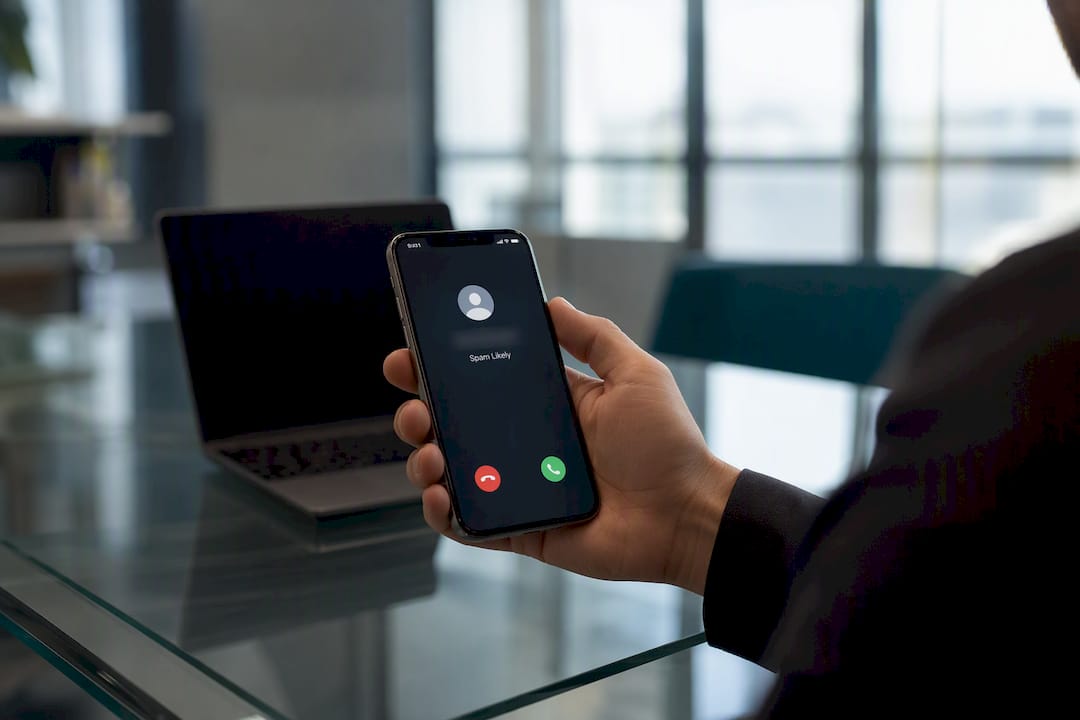
Mobile networks are also far more aggressive about spam filtering than legacy landline systems ever were, because mobile numbers are the primary target for robocalls and scam operations. A name that displays cleanly on a landline can arrive on a mobile phone tagged as "Spam Likely" if the mobile carrier's fraud detection flags the calling pattern, even when the CNAM data itself is accurate.
For businesses, this means testing your outbound name on both landline and mobile recipients matters. A clean landline test doesn't confirm your mobile display is working, and the reverse is equally true.
How Does CNAM Affect Call Blocking and Spam Filters?
CNAM data doesn't just control whether a name shows up. It's also one of the inputs spam filtering systems use to decide whether to let a call through, flag it, or block it outright. A number with no CNAM record at all, or one that returns inconsistent names across lookups, can read as suspicious to automated fraud detection, even if the calls are completely legitimate.
This creates a feedback loop that catches a lot of small businesses off guard. High call volume paired with an unregistered or poorly provisioned CNAM entry looks statistically similar to a robocall operation, so carriers' fraud algorithms may start tagging the number as spam. Once that label sticks, recipients see "Spam Likely" instead of the business name, answer rates drop, and the business has no easy way to self-correct without going through a formal dispute or remediation process with the carrier or a branded-calling provider.
Properly provisioned CNAM data does the opposite. A verified, consistent name tied to a registered business number gives spam filters a positive signal, reducing the odds of a false-positive spam tag. This is part of why branded calling providers position themselves around monitoring, not just registration. They're not just trying to get a name to display. They're actively managing the signals that keep a number out of the spam bucket in the first place.
If your business runs outbound calling campaigns of any real volume, treating CNAM provisioning as connected to spam filtering, rather than a separate cosmetic feature, changes how seriously you should take it.
How Do Businesses Register a Caller Name With Canadian Carriers?
Getting a business name into the caller ID system starts with your carrier or your VoIP provider, since consumer self-service portals for this vary widely in how much control they actually offer.
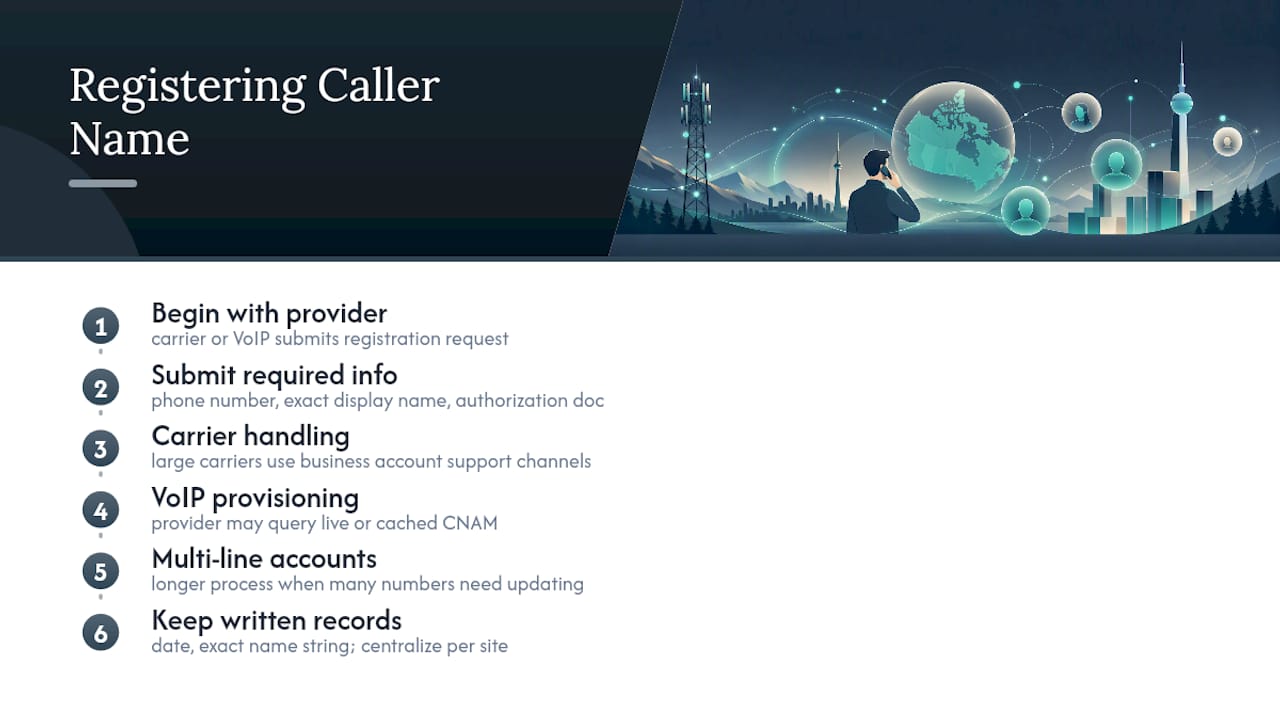
The typical path involves submitting your business phone number, the exact name you want displayed, and documentation proving you're authorized to make changes on that account, such as a business registration number or an account administrator login. Larger carriers like Bell, Telus, and Rogers handle this through business account support channels rather than consumer help lines, and the process can take longer for multi-line accounts where every number needs the same update applied.
VoIP providers add a layer of complexity worth understanding. If your business phone system runs through a VoIP provider rather than a traditional carrier line, that provider controls the CNAM registration process on your behalf, and their internal practices determine whether they query live CNAM data or a cheaper cached source. This is precisely why VoIP lines are more likely to show inconsistent names across networks: the provisioning decision sits with the vendor, not the underlying carrier infrastructure.
For businesses managing this directly, keeping a written record of every registration request, including the date submitted and the exact name string used, matters more than people expect. When a dispute arises over why a name isn't showing on one particular network, that documentation is what moves the ticket forward instead of stalling in a queue. Multi-site businesses juggling several numbers across locations often find it worthwhile to centralize this record-keeping rather than letting each office handle its own carrier relationship independently, an approach Businessvoip's guide to number porting touches on when discussing what to verify before switching providers.
Is Caller ID Spoofing Illegal in Canada?
Yes. Caller ID spoofing, deliberately falsifying the displayed number or name to disguise the true caller, violates the CRTC's Unsolicited Telecommunications Rules when it's used to deceive or defraud recipients. The CRTC has pushed telecom providers to implement STIR/SHAKEN call authentication protocols specifically to combat spoofing at the network level, requiring carriers to verify that the calling number hasn't been falsified before it reaches the recipient's device.
The legal distinction that matters here is intent and purpose. Legitimate business practices, like a company routing calls through a call center and displaying the company's main number rather than the agent's direct extension, aren't spoofing. That's standard, permitted caller ID management. What crosses into illegal territory is falsifying the number or name specifically to mislead the recipient about who's calling, particularly when it's done to facilitate fraud, harassment, or unauthorized solicitation.
Businesses caught engaging in deceptive spoofing face CRTC enforcement action, which can include significant financial penalties under the Telecommunications Act. This is separate from, and in addition to, any fraud charges that might apply if the spoofed calls were part of a scam. For legitimate Ontario businesses, the practical implication is straightforward: displaying your registered company name or main line number is fine and expected, but never misrepresent your identity to make a call seem like it's coming from a government agency, financial institution, or another business you're not affiliated with.
When Should You Call In a Pro for Caller Identity Problems?
If you've verified provisioning, tested across carriers, and your business number is still showing "Unknown" or getting flagged, that's the threshold. Coordinating with Businessvoip means someone who deals with carrier provisioning daily handles the escalation instead of you. Fixed pricing and a lifetime warranty on rented phones mean this doesn't turn into an open-ended expense.
— James
Fix Your Caller Name Display Once, Not Every Month
If your business is stuck manually re-registering a name every time a new location opens or a carrier flags a number, there's a better way to handle it. Businesses running multiple locations or remote offices face this problem constantly, since every new line means another carrier relationship to manage from scratch.
Businesses.ca designs and installs your entire phone system on-site, which means the carrier coordination, number provisioning, and caller name setup happen once, correctly, instead of getting patched together after the fact. For companies running multi-site operations or remote offices, that consistency across every line is exactly what prevents the "Unknown" caller problem from resurfacing every time you add a location. Fixed pricing means no surprise increases down the road, and every rented phone carries a lifetime warranty.
If your business is dealing with inconsistent caller name display across locations, request a phone system design consultation and get your provisioning handled by a team that manages carrier relationships every day.