
Three-way calling is not enough for most Ontario businesses that depend on reliable multi-party conferencing. It caps you at three participants, mixes audio at the endpoints rather than on a server, and drops everyone if the person who initiated the call hangs up. For a quick internal check-in, it works. For client meetings, compliance-sensitive calls, or anything involving more than two other people, it creates real operational risk.
Here is what to require from any conferencing setup you rely on for business:
- Reliability: carrier-grade uptime with a documented SLA, not a consumer feature that can be blocked or interrupted by call waiting
- Moderator controls: the ability to mute, remove, or add participants without ending the session
- Recording and audit logs: mandatory for regulated industries and useful for everyone else
Businessvoip.ca's local Ontario team, led by James, designs and installs managed VoIP systems on-site so every phone works from day one. That matters more than it sounds when your conferencing setup needs to hold up under real business conditions.
Pro Tip: If a provider cannot tell you exactly what happens to your conference call when the host disconnects, that is a sign the system runs on endpoint mixing, not a server bridge. Ask specifically.
Table of Contents
- How does managed conferencing differ from three-way calling?
- Ontario compliance considerations for multi-party calling
- Ready for a fully installed conferencing system in Ontario?
- Key Takeaways
How does managed conferencing differ from three-way calling?
Three-way calling is a legacy consumer feature. One party presses flash, dials a third number, then presses flash again to merge. Audio mixing happens at the phone endpoints, which is why the call typically ends when the initiating party hangs up. There is no central bridge, no recording, and no participant management.

Managed VoIP conference bridges run mixing on a server. The session persists independently of any single endpoint, supports 2–250 or more participants, and gives a moderator real controls: mute, hold, remove, add. Some contact center platforms let agents manage up to six participants individually mid-call.
| Capability | Three-way calling | Managed VoIP conferencing |
|---|---|---|
| Participant limit | 3 | 2–250+ |
| Call persists if host leaves | No | Yes |
| Moderator controls | None | Mute, remove, add |
| Recording | No | Yes |
| Audit logs | No | Yes |
| Compliance-ready storage | No | Yes |
| On-site installation & training | No | Yes (Businessvoip) |
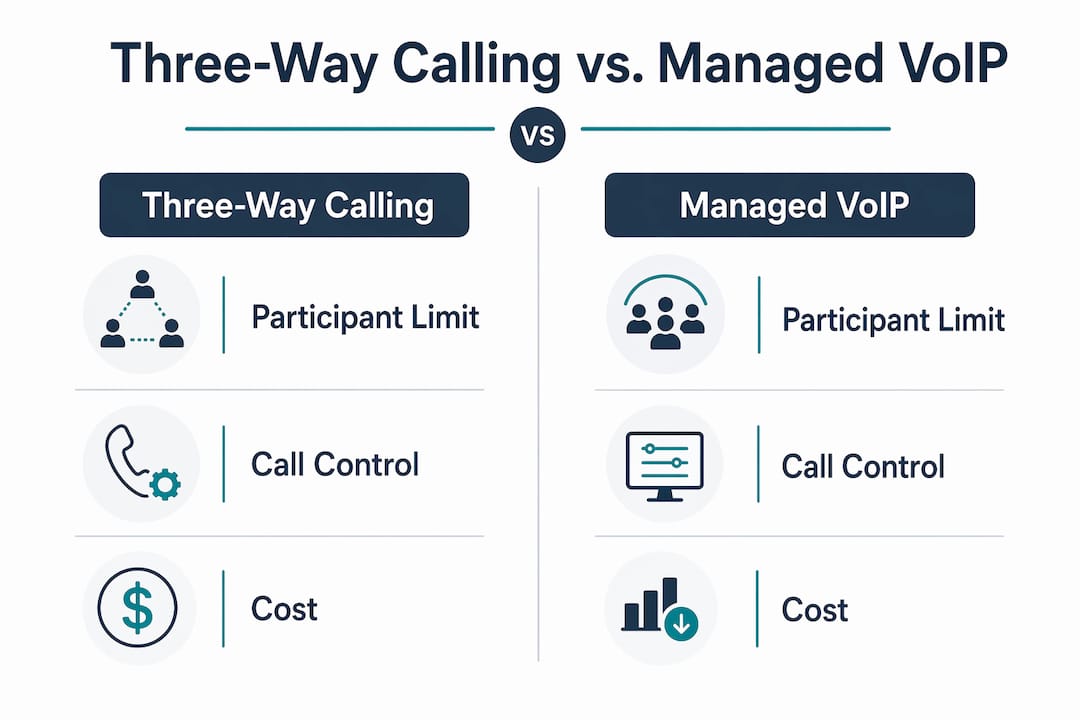
The swap vs. merge workflow on legacy systems also creates a practical hazard: toggling between calls privately before merging is easy to mishandle, and a hot-mic moment during a client call is hard to walk back. Managed bridges eliminate that risk by design.
Total cost of ownership: Three-way calling looks free until you account for what it cannot do. No recording means no audit trail. No moderator controls mean one dropped connection can kill a meeting. Managed conferencing carries higher monthly costs, but predictable SLAs, compliance-ready storage, and on-site support make the math straightforward for any business that takes client calls seriously. For a broader look at what to budget, VoIP system costs and benefits are worth reviewing before you commit to a plan.
Pro Tip: Ask every VoIP vendor for their SLA remedies in writing, not just their uptime percentage. A 99.9% uptime claim with no defined remedy is a marketing number, not a commitment.
Ontario compliance considerations for multi-party calling
Ontario businesses in regulated sectors — legal, financial, healthcare, and real estate — face specific obligations around call recording, data residency, and retention. PIPEDA (and Ontario's own PHIPA for health information) require that recorded calls containing personal information be stored securely, with defined retention and access controls. Three-way calling provides none of that infrastructure. A managed VoIP system with configurable recording, encrypted storage, and audit logs is the only practical way to meet those requirements without building a separate compliance layer on top of a consumer feature. The CRTC also governs how Canadian carriers handle multi-party calls, and any VoIP solution for Ontario must comply with its interconnection and emergency-service rules.
Ready for a fully installed conferencing system in Ontario?
Ontario businesses that need reliable multi-party conferencing should skip the consumer workarounds and get a managed VoIP system installed properly from the start.
Businessvoip designs, cables, programs, and installs your phone system on-site, within about 150 km of Ancaster and province-wide for larger projects. Fixed pricing means no annual increases. Rented phones carry a lifetime warranty. Carrier-grade infrastructure handles tens of thousands of business calls every day, and multi-site deployments are a core part of what the team does. James and the local Ontario team handle number porting, staff training, after-hours routing, and network checks so nothing is left to figure out after the installer leaves. Design your phone system and get a fixed-price quote today.
Key Takeaways
Managed VoIP conferencing with on-site installation is the only reliable path for Ontario businesses that need compliant, multi-party calling beyond three participants.
| Point | Details |
|---|---|
| Three-way calling has a hard limit | Endpoint mixing caps calls at 3 participants and ends the session if the host disconnects. |
| Managed bridges change the equation | Server-side mixing supports 2–250+ participants with moderator controls, recording, and persistent sessions. |
| Compliance is non-optional in Ontario | PIPEDA and PHIPA require secure recording and audit logs that three-way calling cannot provide. |
| TCO favors managed conferencing | Higher monthly costs are offset by predictable SLAs, compliance coverage, and on-site support. |
| Businessvoip installs it for you | Fixed pricing, lifetime warranty on rented phones, and local Ontario on-site installation from day one. |