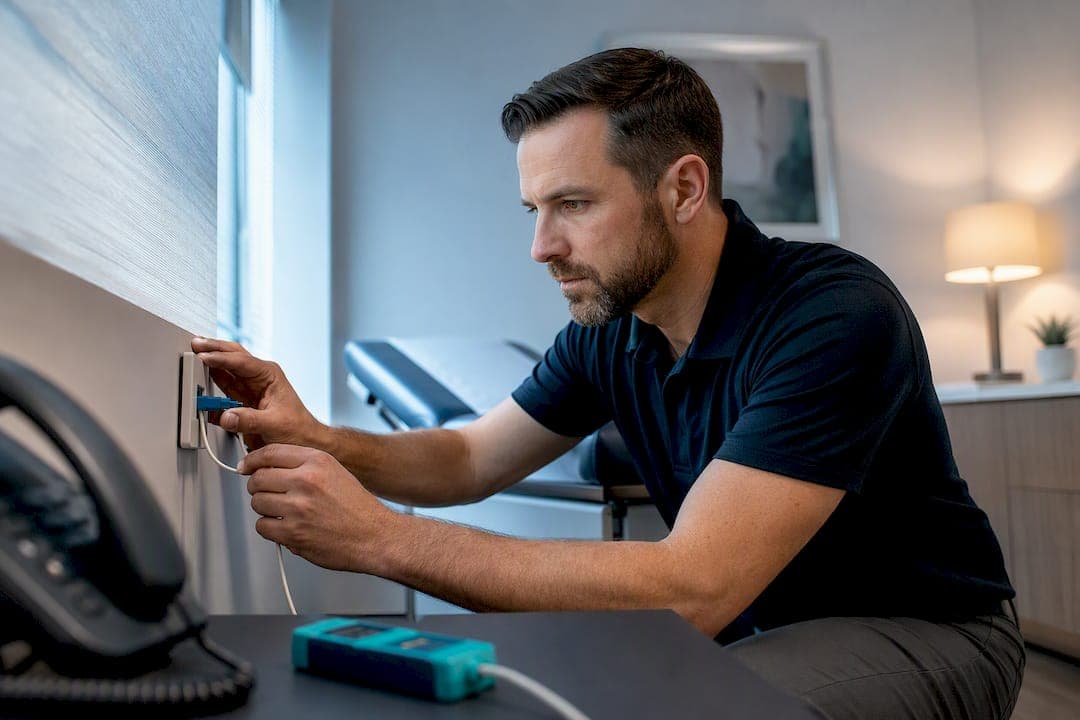
The phone system that actually works for a medical office combines intelligent routing and auto-attendant menus, call queuing with callbacks, detailed analytics, EHR or CRM integration, secure calling with strict access controls, call recording with defined retention, two-way SMS, and voicemail-to-email. Any system touching patient information also has to meet PHIPA and PIPEDA safeguards for consent, minimal collection, and data handling. The sections below break down what each feature does, how to test it before you buy, and how to build a compliance checklist around it.
TL;DR:
- Call analytics should include SIP-level failure reports to identify call routing issues that standard dashboards often overlook.
- Video auto-attendants must offer priority-based routing, escalate urgent calls to a live person, and handle emergency calls with a clear fallback path.
- Vendors must provide documented encryption, data hosting details, role-based access controls, and audit logs to ensure compliance with PHIPA and PIPEDA.
- For multi-location practices, routing and reporting should treat the group as a unified system, with overflow rules and centralized call management.
- On-site installation from a local support team reduces post-launch surprises, number porting issues, and staff training delays.
Table of Contents
- The essential phone system feature checklist for clinics
- What each core feature actually does and how to test it
- PHIPA, PIPEDA, and a practical privacy checklist for phone features
- Building a decision framework to prioritize features for your clinic
- A publisher's view on local installation versus DIY cloud setups
- Emergency call handling and protocol integration
- HIPAA compliance beyond encryption: audit trails and staff training
- Customization options for patient-facing prompts and messages
- Multi-location office support features
- Call backup and business continuity strategies
- Mobile app or remote access capabilities for the phone system
- Measured adoption of AI and advanced features
- Getting a medical office phone system installed without the guesswork
- Sources
- FAQ
The essential phone system feature checklist for clinics
Before you sit through another vendor demo, use this as your baseline. Each item below solves a specific patient-access or compliance problem, and a serious vendor should be able to demonstrate it live rather than describe it in a slide.
- Auto-attendant and intelligent routing: directs callers to the right department or triage line automatically, cutting hold times for urgent calls.
- Call queues and callbacks: lets patients hang up and get called back instead of waiting on hold, which reduces abandoned calls during peak hours.
- Call analytics and SIP-level reporting: shows answer rate, abandonment, and hold time, plus carrier-level failures that basic dashboards miss.
- EHR/EMR and CRM integration: pulls up a patient's chart the moment they call, so staff aren't asking for a birth date twice.
- Secure calling and access controls: encrypts calls and limits who can view logs, recordings, or voicemail transcripts.
- Call recording with retention rules: captures calls for quality or dispute purposes under a documented, time-limited retention schedule.
- Two-way SMS messaging: sends appointment reminders and allows patients to confirm or reschedule by text.
- Voicemail-to-email: routes voicemail as audio or transcript to a monitored inbox so nothing sits unheard overnight.
For a solo or two-provider clinic, routing, queuing, and voicemail-to-email are the non-negotiables. Analytics and SMS follow close behind because they reduce missed calls, which is the most common patient complaint. Full contact-center features like workforce forecasting and live coaching matter more once you're running multiple lines or several locations, according to ISG Research's healthcare buyers guide, which frames routing as the foundation and treats advanced tools as additions once volume justifies them.
What each core feature actually does and how to test it
Intelligent call routing and auto-attendant does more than play a recorded greeting. A well-configured menu separates urgent clinical calls from billing or prescription refill requests, and it can route by skill, meaning a call about lab results reaches a nurse rather than a front-desk receptionist. Ask a vendor to show you priority-based routing: can an urgent-care line jump ahead of a routine scheduling call, and can the system escalate automatically to a live person if no one answers within a set number of rings.
Queues, callbacks, and overflow handling keep patients from hanging up in frustration. Instead of holding music, a modern queue offers a callback option that preserves the caller's place in line. Position announcements ("you are second in queue") reduce perceived wait time, and overflow rules should reroute calls to a second location or an answering service once a queue exceeds a set threshold, particularly after hours.
- Ask for: documented SLA thresholds (for example, answer within 30 seconds or offer a callback).
- Ask for: after-hours behavior that's configurable without a service call.
Analytics and reporting need to go beyond "calls answered" and "calls missed." Ordinary contact-center dashboards can miss busy signals, misrouted calls, and abandonment that happens before a caller even reaches the auto-attendant, according to IntelePeer's SmartAnalytics research on healthcare call visibility. That's why SIP and carrier-level reporting matters: it surfaces the failures that never show up in a simple answered-call percentage.
Pro Tip: Ask every vendor to run a live SIP-level failure report during the demo, not just a call log. If they can't produce one on the spot, they probably don't collect that data at all.
EHR/EMR and CRM integration turns a ringing phone into a working record. Screen-pop shows the patient's chart or account the instant the call connects, based on caller ID matching, and the best systems auto-log the call into the patient's file without manual entry. Click-to-call from within the EHR saves staff from re-dialing numbers by hand.
SMS and two-way messaging need a documented consent trail before they touch protected health information. Patients should opt in explicitly, templated reminders should avoid clinical detail beyond an appointment time, and every message needs a working opt-out. This is a feature patients notice quickly: a missed reminder often means a missed appointment.
Voicemail, voicemail-to-email, and recordings carry their own retention and consent obligations. Recordings used for quality assurance or dispute resolution should sit behind role-based access, and patients should be told when a call is recorded, consistent with guidance in Canada's call recording laws. Retention periods should be written down, not left to whatever the vendor's default happens to be.
Security is the feature category most often glossed over in a sales pitch. At minimum, ask for TLS 1.3 in transit, AES-256 at rest, role-based access controls, and audit logging that shows who accessed which call or recording and when. According to Mihron AI's guide to PHIPA and AI in healthcare, Ontario practices should evaluate any phone feature touching personal health information against safeguards covering encryption, access control, audit logs, controlled mobile access, and retention rules, and those expectations belong in the vendor contract itself, not just the sales deck.
PHIPA, PIPEDA, and a practical privacy checklist for phone features
Any phone feature that stores or transmits patient information falls under PHIPA if you practice in Ontario, and under PIPEDA more broadly across Canada. Both frameworks share the same core obligations: collect only what's necessary, get consent for that collection, protect the data with reasonable safeguards, retain it only as long as needed, and be transparent about how it's used. A phone system that stores voicemail transcripts, call recordings, or SMS threads containing health details is handling personal health information whether or not anyone thinks of it that way.
Use this checklist when evaluating a vendor or auditing your current setup:
- Confirm where call data, recordings, and transcripts are hosted and whether that meets your practice's data residency expectations.
- Verify encryption in transit and at rest, and ask for documentation, not just a verbal assurance.
- Request evidence of audit logging: who accessed which recording, voicemail, or call log, and when.
- Get the vendor's documented breach response process in writing before signing.
- Ask whether the vendor holds SOC 2 or an equivalent independent security assessment.
- If an AI receptionist or triage bot is part of the system, confirm patients are told they're speaking with an automated system and given a clear opt-in or opt-out path.
- Review exactly what personal health information the AI collects and stores, and for how long.
Mihron AI's PHIPA guide notes that an AI-enabled or automated reception line needs explicit disclosure, limited data collection, and clear escalation rules for emergencies, plus a documented review of where recordings and transcripts are processed. A single vendor claim like "PHIPA-ready" isn't proof of anything on its own: ask for the documentation behind it. Operationally, that means updating your privacy policy, adjusting consent language patients hear on the phone, training staff on what they can and can't say about recording, and writing specific data-handling clauses into your vendor contract rather than relying on a general terms-of-service page.
Building a decision framework to prioritize features for your clinic
Not every clinic needs the same phone system. A single-site practice with a part-time receptionist has a different problem than a multi-location group running a shared call center. Start by measuring your actual call volume and complexity before buying anything: how many calls come in per day, what percentage go unanswered, and where callers get stuck.
The priority order that works for most practices is routing and queuing first, analytics second, and full workforce management last. According to ISG Research's Buyers Guide, most small practices need routing, basic queues, voicemail, and reporting, while forecasting tools and quality monitoring only pay off once call volume and staffing complexity grow. Buying the larger feature set before you need it tends to add administrative overhead without fixing the actual bottleneck at the front desk.
Before signing anything, run this demo checklist:
- Request a live SIP-level failure report, not a summary dashboard.
- Ask to see role-based access controls in action, including what a front-desk user can and cannot view.
- Run a real integration test with your own EHR or practice management software.
- Get written confirmation of where your data is hosted and stored.
Pro Tip: Treat a vague answer about encryption or retention as a red flag, not an oversight. A vendor that can't specify AES-256 at rest or a written retention schedule usually doesn't have one.
A publisher's view on local installation versus DIY cloud setups
Fully cloud-based, self-managed VoIP setups look simple until the first phone doesn't ring correctly or a queue rule needs adjusting mid-week. On-site design and installation, where a local team programs the system, runs the cabling, and tests every extension before staff touch it, tends to produce fewer post-launch surprises. That includes number porting handled correctly the first time and staff trained on the actual buttons they'll press, not a generic manual.
Some vendors design, program, cable, and install phone systems on-site, and may offer warranties on rented phones and fixed pricing arrangements. That combination of local support and hands-on setup addresses a real gap: a phone system that works on paper but never gets configured correctly in the exam room.
Emergency call handling and protocol integration
A medical office phone system needs a defined path for emergency calls that doesn't depend on a receptionist recognizing urgency in real time. Menu design should let a caller reach a live person immediately if they select an urgent option, bypassing queue position entirely. Some systems allow integration with clinical protocols, so a call flagged as urgent triggers a simultaneous alert to a nurse's mobile app or desk phone rather than sitting in a standard queue.
Practices should document what happens when a caller says "this is an emergency" during business hours versus after hours. After-hours emergency routing typically forwards to an answering service, an on-call provider's mobile number, or a recorded message directing callers to call 911 or go to the nearest emergency department. That message needs to be reviewed periodically, since an outdated after-hours greeting is a common and avoidable failure point.
Ask any vendor how the system distinguishes an emergency call from a routine one, whether that distinction can be configured by keyword or menu selection, and what happens if the on-call number doesn't answer. A system with no fallback path, meaning a call simply rings out with no escalation, is not appropriate for a clinical setting regardless of how polished its other features are. Build the escalation path first, then layer routing efficiency on top of it.

HIPAA compliance beyond encryption: audit trails and staff training
Encryption is table stakes, not the whole compliance picture. A phone system used in a practice covered by HIPAA in the United States needs audit trails that record who accessed a voicemail, recording, or call log and when, because that log is often the first thing an auditor or investigator requests after an incident. Without it, a practice has no way to demonstrate who touched protected health information or whether access was appropriate.
Staff training is the other half of the equation that a security feature alone can't cover. Front-desk staff need clear guidance on what they can say when confirming a patient's identity over the phone, how to handle a caller asking for someone else's information, and what to do if a recorded call needs to be pulled for a documented reason. A system with airtight encryption still fails compliance if staff routinely leave voicemail transcripts open on an unlocked screen or share login credentials.
Practical steps: require unique logins for every staff member rather than a shared extension password, review audit logs periodically rather than only after a complaint, and put phone-specific privacy training into new-hire onboarding rather than treating it as a one-time policy memo. A vendor contract should specify who is responsible for maintaining those audit logs and for how long they're retained.
Customization options for patient-facing prompts and messages
Generic, default greetings tell patients nothing useful and often waste their time. A configurable auto-attendant should let a practice record its own hours, department names, and holiday closures rather than relying on a vendor's stock recording. Prompts should be written in plain language a patient can act on immediately: which key to press for prescription refills, which for billing, which for a nurse line.
Language options matter for practices serving a multilingual patient base, and a system that supports multiple prompt languages selected at the start of the call reduces frustration for patients who aren't fluent in the default language. Seasonal or situational updates, such as a temporary message about a closure or a schedule change, should be editable by office staff directly rather than requiring a vendor service ticket.
SMS templates deserve the same attention. A reminder text should state the appointment time and location without including clinical detail, and the wording should be reviewed periodically to make sure it still matches actual office procedures. Ask a vendor whether prompt and message editing requires technical support or can be handled by office staff through a simple portal, since a system that locks routine wording changes behind a support call adds delay every time your hours or protocols shift.
Multi-location office support features
Practices operating more than one location need routing and reporting that treat the group as a single system rather than several disconnected phone lines. A shared directory should let staff at one location transfer a call directly to a provider or department at another site without asking the patient to hang up and redial. Centralized reporting should show call volume and abandonment by location, so a manager can see whether one site is understaffed on the phones while another has slack.
Overflow rules across locations matter during peak hours: a call unanswered at a busy site can route to a quieter location's front desk instead of going to voicemail. That requires the system to know which staff are available where, which is a configuration detail worth testing directly in a demo rather than taking on faith.
Number management also gets more complex with multiple sites. Each location typically needs its own direct number while still allowing calls to route through a shared main line, and porting existing numbers during a system change needs to happen without a gap in service. For groups considering this kind of setup, a dedicated resource on multi-site and remote office phone systems covers the configuration details specific to running several locations on one platform.
Call backup and business continuity strategies
A phone system that fails completely during an internet outage or a carrier problem isn't just an inconvenience in a medical office, it's a patient-access failure. Continuity planning starts with redundant internet connections where feasible, since a single point of failure at the network level takes down every phone at once regardless of how good the phone system itself is.
Cloud-hosted systems typically offer automatic failover to a mobile app or a forwarding number if the office internet goes down, so calls keep ringing through even when the primary connection doesn't. Ask a vendor directly how failover works: does it happen automatically, how long does it take, and where do calls go during the gap. A system that requires a manual reconfiguration during an outage adds delay exactly when speed matters most.
Backup plans should also cover carrier-level SIP failures, not just an office internet outage. Reliable bandwidth and quality of service settings play a direct role here, and practices should review their network requirements for VoIP before assuming a standard office connection can handle voice traffic reliably during peak hours. Document a written continuity plan that covers who staff call, what number patients are told to use, and how quickly the practice expects service restored, then test that plan periodically rather than assuming it works.

Mobile app or remote access capabilities for the phone system
A mobile app extension of the office phone system lets a provider or on-call nurse answer or make calls from a personal device using the practice's main number, which matters for after-hours coverage and for practices with staff working from more than one site. The call should look and sound identical to the caller regardless of whether staff answer from a desk phone or a mobile app.
Remote access needs the same security scrutiny as the office system itself. A mobile app that caches voicemail transcripts or call logs on a personal device without encryption creates a compliance gap that's easy to overlook. Ask whether the app requires a separate login with role-based permissions, whether it can be remotely wiped if a device is lost, and whether call recordings accessed through the app are logged the same way as recordings accessed on-site.
For practices with providers who round between locations or take call from home, remote access isn't optional, it's how the phone system stays useful outside the building. Test the mobile app during any demo the same way you'd test a desk phone: place a call, check call quality, and confirm the app shows the same patient information as the office system rather than a stripped-down version.
Measured adoption of AI and advanced features
The order that works: measure first, secure second, automate third. Get analytics running before adding anything automated, so you know your actual answer and abandonment rates. Lock down encryption, access controls, and consent language before layering in an AI receptionist. Only then pilot AI features, and insist on compliance documentation, not just a sales assurance, during any proof-of-concept trial.
— James
Getting a medical office phone system installed without the guesswork
Reading a feature checklist is one thing. Getting every phone, queue rule, and integration actually working on launch day is another problem entirely, and it's the one most clinics underestimate. BusinessVoip.ca sends a local Ontario team to design, program, cable, and install the entire system on-site, so a practice never has to configure hardware or troubleshoot a setup alone.
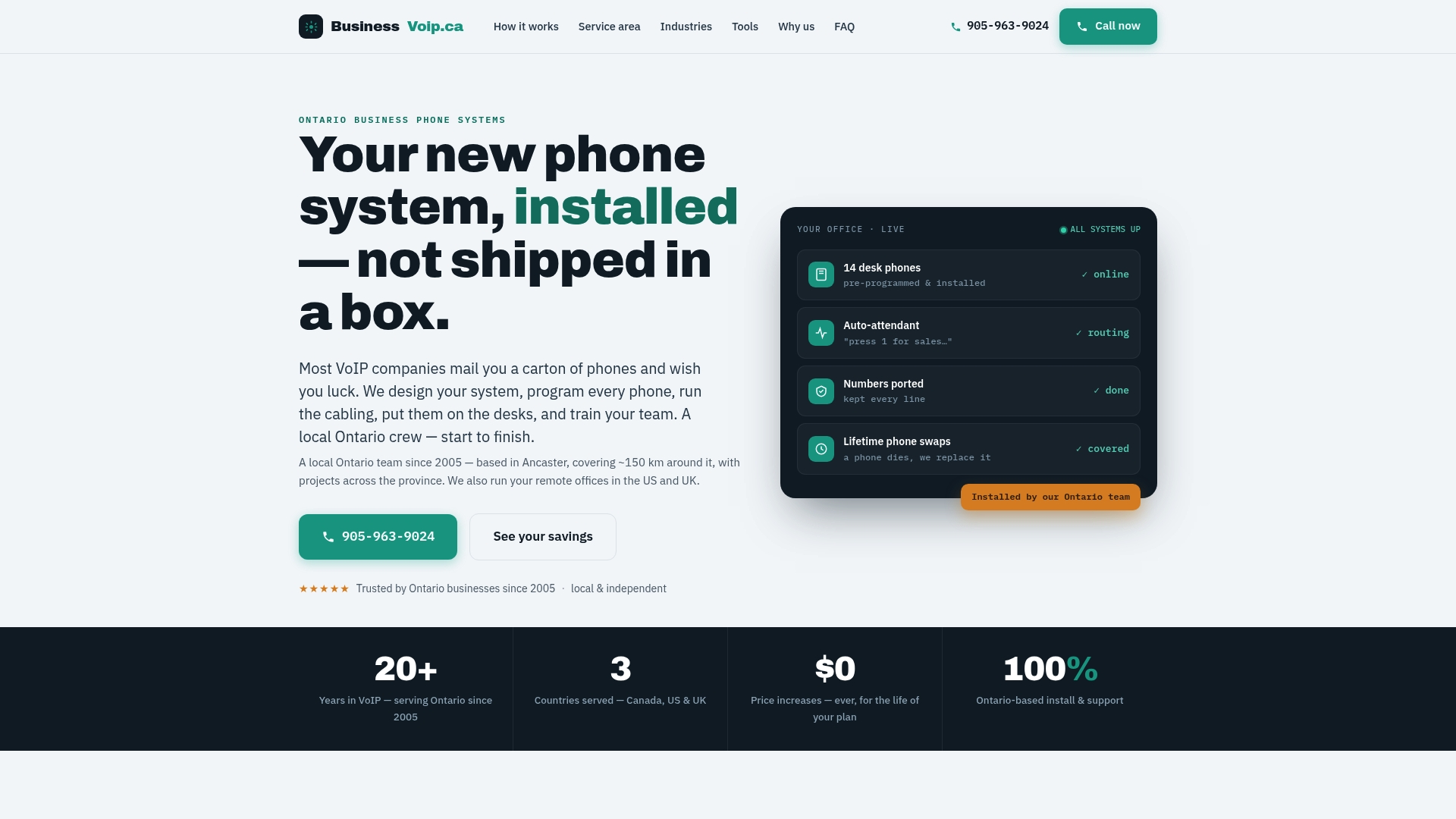
That approach fits clinics that want a phone system handled from network check to staff training without adding IT work to an already full front desk. Pricing is fixed with no annual increases, and rented phones carry a lifetime warranty. Practices considering a new system or a replacement for an aging one can review Businessvoip and get in touch to discuss what a fully installed setup looks like for their location.
This article is general information, not a substitute for advice from a qualified doctor. Consult a qualified healthcare professional about your own circumstances before acting on anything here.
Sources
- ISG Buyers Guide: Contact Center Healthcare (2025)
- SmartAnalytics for Healthcare | Patient Access & Call Analytics - IntelePeer
FAQ
What are the etiquette rules for phone use in a medical office?
Staff should answer promptly, identify the practice and themselves, and verify patient identity before discussing any health information. Calls involving sensitive details should be handled quietly and away from waiting-room earshot, and hold times should be acknowledged rather than left silent.
What should a medical office voicemail message include?
A clear voicemail should state the practice name, current hours, and what to do in a medical emergency, directing urgent callers to call 911 or go to the nearest emergency department. It should also tell callers roughly when to expect a callback and offer an alternative contact method if one exists.
How should staff answer the phone in a medical office?
Staff should answer within a few rings, state the practice name and their own name, and ask how they can help before requesting any identifying information. Verifying identity before discussing appointment or health details protects patient privacy and should be standard on every call.
What features come standard on a call center phone system?
Common features include automated call routing, queue management, real-time and historical reporting, call recording, and integration with customer or patient records. Healthcare-specific setups add analytics that surface SIP or carrier-level failures, which standard call center reporting can miss entirely.