
VoIP handles international office calling well when you pick the right architecture for your situation. Hosted UCaaS suits companies that want fast global reach without hardware, while on-prem SIP trunking fits offices that need tighter control and firm E9-1-1 guarantees. Before signing anything, confirm three things with any vendor: emergency-calling support, local number availability in your target countries, and whether they use direct carrier interconnects.
TL;DR:
- Providers with direct interconnects and local licenses in target countries generally offer better call quality and more reliable caller ID presentation.
- On-prem SIP trunks provide full control over routing and emergency call handling but require dedicated IT support for maintenance and upgrades.
- Proper E9-1-1 support varies: native integrated services support full location routing, while international providers might only offer interim solutions.
- Total VoIP costs often include hidden fees for emergency services, DID numbers in high-cost markets, and call recording storage, which can outweigh low headline rates.
- On-site installation by local technicians reduces deployment risks for multi-site or regulated offices, ensuring network, number porting, and emergency features are correctly configured upfront.
Table of Contents
- What Is International Office VoIP and How Does It Route Calls?
- What Technical Features Matter Most for Call Quality?
- Which Deployment Model Fits Your Office?
- What Canadian Rules Apply to International VoIP Calling?
- Where Does Your VoIP Bill Actually Go?
- How Do You Actually Choose a Provider?
- Why On-Site Installation Changes the Outcome
- Get Your VoIP System Installed by People Who Show Up
- Sources
- FAQ
What Is International Office VoIP and How Does It Route Calls?
International office VoIP is a phone system that sends voice traffic over the internet instead of copper phone lines, letting one company route calls between offices in different countries as if they were all on the same network. The mechanics behind that experience vary more than most buyers expect.
A few terms come up constantly during vendor calls:
- DIDs (direct inward dialing numbers), also called virtual numbers, are local phone numbers assigned to your business in a specific country or city, even if no one physically sits there.
- SIP trunks connect your existing PBX to the public phone network over IP, replacing physical phone lines with a virtual connection.
- Hosted UCaaS puts your whole phone system in the cloud, managed by the provider, with no on-site server to maintain.
- Fixed VoIP ties a number to a physical address; nomadic VoIP lets that same number move with an employee's laptop or app.
How a provider routes your calls matters as much as which plan you buy. Some carry traffic over their own direct interconnects with local telecom carriers abroad. Others rely on local breakout points, or simply resell capacity from a third-party carrier. That distinction affects call quality, and it directly shapes whether your caller ID displays correctly and whether people overseas actually pick up.
What Technical Features Matter Most for Call Quality?
Voice quality on an international call comes down to bandwidth, codec choice, and how the provider manages the connection end to end. Codecs like G.711 offer wide compatibility across older systems, while G.722 and Opus deliver clearer audio and handle bandwidth constraints better, a point the SIP trunk selection guide from Cainiao Voice lays out in detail. For quality assurance, look at route metrics rather than marketing claims: ASR (answer seizure ratio), ACD (average call duration), PDD (post-dial delay), and MOS (mean opinion score) tell you whether a route is actually reliable, not just cheap.
Security and reachability deserve equal weight:
- SIP traffic should run over TLS with SRTP encryption, not plain unencrypted sessions.
- IP whitelisting and active fraud monitoring catch toll fraud before it drains your bill.
- Providers with direct interconnects or local voice licences in your target country tend to produce higher reachability and fewer STIR/SHAKEN spam-flagging issues than those reselling generic international routes.
- Local DIDs improve pickup rates for outbound sales and support calls; toll-free or centralized numbers work better for inbound-only use cases.
Pro Tip: Ask any prospective provider to show you their route quality metrics for the specific countries you're calling, not just their overall network average. A provider can look great on paper and still route your Germany calls through three intermediaries.
Which Deployment Model Fits Your Office?
Three deployment patterns cover almost every business situation, and picking the wrong one is the single most common regret buyers report after the fact.
- On-prem PBX with SIP trunks gives you full control over routing, local number handling, and E9-1-1 configuration, but your IT team owns the maintenance and upgrade cycle.
- Hosted UCaaS scales quickly, pools DIDs across many countries from one admin console, and removes hardware upkeep, though local interconnect quality still depends entirely on your provider's carrier relationships.
- Hybrid setups work well for companies migrating in phases or running multiple offices at different stages of a rollout, and they typically integrate with CRM systems, call recording, and mobile apps along the way.
Whichever path you choose, expect a real deployment sequence behind it: a network assessment to confirm bandwidth and QoS headroom, number porting from your old carrier, and failover setup so calls survive an internet blip. A local installer who handles that sequence on-site, rather than mailing you a box of phones, removes most of the guesswork from that first week.
What Canadian Rules Apply to International VoIP Calling?
Roughly a third of Canadian VoIP complaints tracked by regulators trace back to emergency-calling confusion, which is exactly why the CRTC treats 9-1-1 access as a mandatory obligation rather than an optional feature.
The CRTC splits VoIP service into three categories that matter enormously for how emergency calls get handled. Fixed/native VoIP ties your number to a physical address and supports full E9-1-1, including automatic location routing to the correct dispatch center. Fixed/non-native and nomadic services, common with international providers and remote-work setups, must implement an interim 9-1-1 solution that routes calls based on your registered address instead of automatic detection.

This gap catches a lot of buyers off guard. Many international providers sell Canadian DIDs freely but treat emergency calling as a paid add-on rather than a default feature, which means an office could go live for weeks without knowing 911 calls aren't routing correctly. On top of registration, the CRTC recommends battery backup and alternate routing plans, since VoIP service drops during a power or internet outage unless you've built in a fallback. Our E911 for VoIP Canada guide walks through exactly what to confirm before you sign a contract.
Where Does Your VoIP Bill Actually Go?
Vendors charge for international VoIP in three overlapping ways, and the sales pitch rarely leads with the one that costs you the most. Per-user subscription pricing looks predictable on a spreadsheet, per-minute outbound rates reward light callers and punish heavy ones, and SIP trunk channel pricing charges by simultaneous call capacity rather than usage.
The line items that quietly inflate a "low" quote include:
- E911 provisioning fees, sometimes billed per location or per number
- DID charges that scale by country, with some markets costing far more than others
- Call recording storage, especially for compliance-heavy sectors
- Premium interconnect surcharges for routes with better answer rates
Compare total cost of ownership, not the headline number. A plan advertising a rock-bottom monthly rate can still cost more overall once you add per-minute international charges on top, especially for offices that call abroad daily rather than occasionally.
How Do You Actually Choose a Provider?
Run every shortlisted vendor through the same set of questions before signing anything, because vague answers here predict real problems later.
- Ask directly how they handle E9-1-1: automatic routing, an interim solution, or nothing at all.
- Confirm DID provisioning in each country your offices operate in, and how long activation takes.
- Ask whether they use direct interconnects or resell capacity from another carrier.
- Request their SLA terms for uptime, and their documented failover process during an outage.
- Confirm STIR/SHAKEN support so your outbound calls don't get flagged as spam.
- Clarify the scope of on-site installation, if any, versus a self-install box shipped to your office.
Score each vendor on technical fit, installation and support capability, pricing transparency, sector references, and security posture. Watch for red flags like vague answers about emergency calling, reluctance to share route quality metrics, or pricing that omits E911 and DID fees until the contract stage.
Pro Tip: Get every answer to these questions in writing before you sign. A provider that hedges on E9-1-1 specifics during a sales call rarely improves once you're a customer.
Why On-Site Installation Changes the Outcome
Most VoIP rollout failures trace back to skipped steps: a network that was never load-tested, numbers ported without a fallback plan, or E9-1-1 configured after go-live instead of before. A local team that designs, cables, and programs the system on-site catches those problems while they're still cheap to fix, not after 20 employees can't dial out. That's a model run by some providers, backed by carrier-grade infrastructure carrying many business calls daily.

Local teams also move faster on the parts that trip up remote-only providers, particularly number porting and E9-1-1 provisioning, because someone is physically present to verify the network before flipping the switch. For offices juggling remote locations in the US and UK alongside an Ontario headquarters, that hands-on verification matters more, not less.
Get Your VoIP System Installed by People Who Show Up
Some providers offer an alternative to shipped-box VoIP setups for businesses juggling international calling needs. Instead of handing you hardware and a setup guide, they provide local teams that design, program, cable, and install systems on-site so phones work from day one.
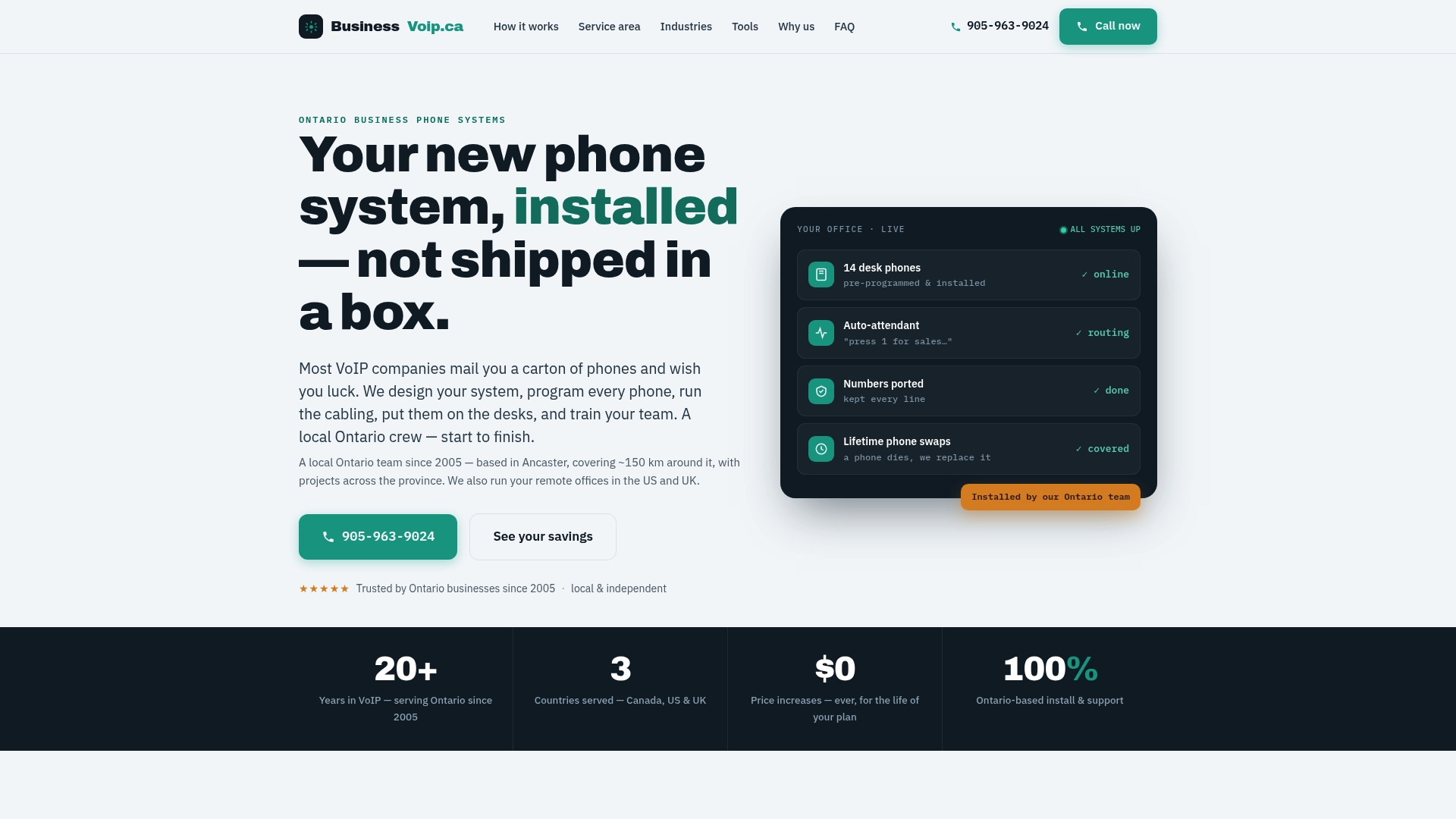
That matters most for multi-site operations, regulated industries, and any office where a dropped 911 call isn't an acceptable risk. Businesses running multi-site or remote office setups benefit especially, since centralized administration across locations only works cleanly when the initial install was done right. Fixed pricing means no annual rate hikes, and rented phones carry a lifetime warranty, so there's no surprise hardware replacement bill down the road.
If you're weighing hosted UCaaS against on-prem SIP trunking for an international office setup, book a network and E9-1-1 check with Businessvoip before you commit to either path. It's the fastest way to know exactly what your current network can handle and what needs fixing first.
Sources
- VoIP and 9-1-1 — Canadian Radio-television and Telecommunications Commission (CRTC)
- International SIP Trunk Selection Guide | Cainiao Voice
FAQ
What Is the Best VoIP Provider for International Calls?
There's no single best provider for every office; the right choice depends on whether you need tight E9-1-1 control, multi-country DID pools, or on-site installation support. Providers with direct carrier interconnects in your target countries generally deliver better reachability than those reselling international routes.
Is VoIP Legal in Canada?
Yes, VoIP is fully legal in Canada, and the CRTC regulates it directly, including requiring providers to support 9-1-1 access either natively or through an interim solution. Any provider operating in Canada must comply with these emergency-calling rules regardless of where its infrastructure is based.
Can I Make International Calls Using VoIP?
Yes, VoIP handles international calling as a core function, typically through SIP trunks or hosted UCaaS plans with international DID pools. Call quality depends on the provider's codec support and whether they route your calls through direct interconnects or resold capacity, so ask about route quality metrics before committing.
Is There a Free VoIP Service for International Calls?
Consumer apps offer free VoIP calling between users of the same app, but business-grade international office VoIP with reliable numbers, E9-1-1 support, and SLAs isn't offered free by any credible provider. Businesses evaluating cost should compare total ownership, including per-minute rates and E911 fees, rather than chasing a free tier meant for casual personal use.
Do I Need On-Site Installation for International Office VoIP?
On-site installation isn't strictly required for every setup, but it substantially reduces rollout risk for multi-site or regulated offices where E9-1-1 provisioning and network readiness matter. Some providers offer local teams who manage design, cabling, and installation so business phone systems work correctly from the first call.