
An auto attendant phone system is defined as an automated telephony feature that answers incoming calls, plays a recorded greeting, and routes callers to the right department or person without a live receptionist. Every Ontario small business that handles more than a handful of calls per day stands to benefit from this technology. Monthly subscription fees run $15–$40 per user for standard plans, with AI-specific tiers starting higher. The industry standard term for the underlying technology is Interactive Voice Response, or IVR, and the two terms are often used interchangeably in business telephony. Understanding both terms helps you evaluate vendors and compare plans accurately.
How does an auto attendant phone system work?
An auto attendant answers every call with a pre-recorded greeting, then presents the caller with a menu of options. The caller responds by pressing a key or speaking a command, and the system routes the call accordingly. Cloud-based VoIP systems have replaced analog hardware for most small businesses, bundling voice, video, messaging, and automated answering into a single monthly plan.
The core mechanics break down into four steps:
- Automated greeting: The system picks up instantly and plays your recorded message, including your business name and available options.
- Caller input: The caller presses a keypad digit or speaks a command. Basic systems use touch-tone input only; advanced platforms add voice recognition.
- Call routing: The system sends the call to the correct extension, department queue, voicemail box, or a live backup line based on the caller's input.
- Fallback handling: If the caller makes no selection or presses 0, the system transfers to a live agent or plays an after-hours message.
Multi-level menus add a second layer of options after the first selection. A caller who presses 2 for "Billing" might then hear options for "Payment inquiries" or "Invoice disputes." This depth is useful for larger offices but creates friction for smaller operations with fewer departments. The right configuration depends on how many distinct call types your business actually receives each week.
What are the key benefits for small businesses?

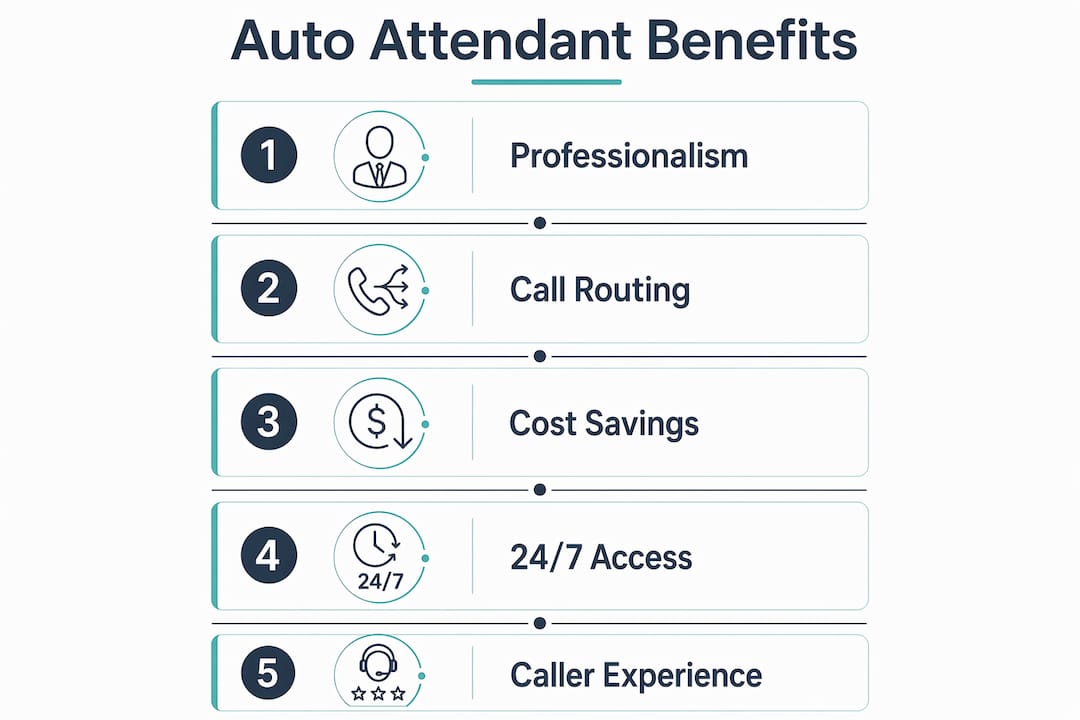
The single biggest advantage of automated phone answering is 24/7 availability without adding staff. A caller who reaches your office at 7:00 PM on a Friday still hears a professional greeting, gets routed to voicemail, and receives a callback prompt. That experience builds trust in a way that a busy signal never will.
The operational benefits go further:
- Cost efficiency: A live receptionist in Ontario costs $35,000–$50,000 per year in salary and benefits. A hosted IVR phone service costs a fraction of that, with no sick days or turnover.
- Consistent caller experience: Every caller hears the same greeting, in the same tone, every time. Human receptionists vary by mood, workload, and experience level.
- High call volume handling: AI-powered virtual receptionists handle unlimited concurrent calls without hold queues, which is a direct advantage during busy periods like Monday mornings or post-holiday rushes.
- CRM and scheduling integration: Modern call routing solutions connect directly to your customer database and calendar, logging call details automatically and reducing manual data entry.
- Professionalism at any size: A three-person shop in Kitchener can present the same polished phone experience as a 50-person firm in Toronto.
The professionalism point matters more than most owners expect. Callers form an opinion about your business within the first ten seconds of a phone interaction. A clear, well-structured greeting signals that your operation is organized and reliable.
How to set up and configure your auto attendant system
Setup on a standard hosted VoIP platform takes 30 to 60 minutes for a basic configuration. That estimate assumes you have your call flow mapped before you log into the admin portal. Skipping the planning step is the most common reason small business owners end up with menus that confuse callers.
Follow these steps for a configuration that works from day one:
- Choose a cloud-based hosted VoIP plan that includes auto attendant as a built-in feature, not a paid add-on. Most business-grade plans in the $15–$40 per user range include it.
- Map your call flow around caller needs. Design menus around the top reasons people call you, not around your internal org chart. If 70% of calls are about bookings, that option goes first.
- Limit main menu options to three. Menus with more options increase hang-up rates. Three clear choices cover most small business needs without overwhelming callers.
- Always include a "Press 0" option for callers who want a live person. Removing this option frustrates callers and drives them to competitors.
- Record separate greetings for business hours and after-hours. Your daytime greeting can offer full menu options. Your after-hours greeting should acknowledge the time and set a clear callback expectation.
- Test from multiple devices. Call your own number from a cell phone, a landline, and a VoIP softphone. Listen for audio quality issues and confirm every routing path works correctly.
- Review menu usage monthly. Most hosted platforms log which options callers select. If option 3 gets almost no presses, either the label is unclear or that call type is rare enough to remove.
Pro Tip: Record your greeting in a quiet room using a USB condenser microphone rather than a laptop built-in mic. Audio quality directly affects how professional your business sounds to first-time callers.
The monthly review step is the one most owners skip. Call data tells you exactly where callers drop off or get confused. Treating your auto attendant as a "set it and forget it" tool means leaving real caller experience improvements on the table.
What AI capabilities are changing auto attendant technology?
AI is shifting business phone automation from rigid menus to natural conversation. Traditional IVR systems require callers to listen to options and press a key. AI-powered systems let callers say what they need in plain language and respond accordingly.
The practical capabilities now available to small businesses include:
- Natural language call handling: Instead of "Press 1 for sales," the caller says "I need a quote for a new roof," and the AI routes or responds directly.
- Real-time appointment booking: AI systems book appointments by accessing live calendar availability, negotiating times verbally, and sending automated confirmations. No human involvement is needed.
- CRM integration: Auto attendant and CRM connections log call details, update contact records, and trigger follow-up workflows automatically.
- Unlimited concurrent calls: AI handles as many simultaneous calls as your business receives, with no hold music and no queue.
- Consistent performance: An AI receptionist never has a bad day, never puts a caller on hold to check something, and never transfers to the wrong extension.
"AI-powered virtual receptionists operate 24/7, handle unlimited concurrent calls, and improve lead capture by performing real-time appointment booking and CRM integration. They answer calls instantly and provide consistent service without fatigue."
The cost entry point for AI-specific plans starts around $59 per month for entry-level services. That is higher than a basic IVR plan but still well below the cost of a part-time receptionist. For medical offices, dental and medical VoIP systems in Ontario already use this integration to handle appointment reminders and patient routing without adding admin staff.
Key Takeaways
An auto attendant phone system delivers the most value when it is configured around caller needs, kept simple, and reviewed regularly against real call data.
| Point | Details |
|---|---|
| IVR is the industry standard term | Auto attendant and IVR refer to the same core technology; knowing both helps you evaluate plans accurately. |
| Keep menus to three options | More than three main options increases hang-up rates and caller frustration. |
| Always include a live-person escape | A "Press 0" option is non-negotiable for retaining callers who need human help. |
| AI handles unlimited concurrent calls | AI-powered systems eliminate hold queues and book appointments in real time, without extra staff. |
| Monthly review improves performance | Call data shows where callers drop off; use it to simplify menus and fix routing gaps. |
What I've learned from watching businesses get this wrong
Most small business owners I've seen set up an auto attendant make the same mistake: they build the menu to reflect how their company is organized internally, not how their customers think. The result is a caller who wants to ask about a delivery date pressing through three layers of options before reaching someone who can help. By that point, half of them have already hung up.
The fix is simple but requires honesty. Pull your call log for the last 30 days and list the top five reasons people called. Build your menu around those five reasons, in order of frequency. That single change does more for caller satisfaction than any recording quality upgrade or hold music selection.
The other pattern I see constantly is the removal of the "Press 0" option because the owner doesn't want calls going to a general line. That instinct is understandable, but the data is clear. Hybrid models that pair automation with live fallback consistently outperform fully automated systems on caller satisfaction. Automation handles volume. Humans handle complexity. The best systems do both.
If you are running a multi-site operation or managing remote staff, the routing logic gets more important, not less. A multi-site VoIP setup needs call flows that account for which location a caller is trying to reach and which staff are available at any given time. Getting that wrong means callers bounce between locations and repeat themselves. Getting it right means your phone system feels like one unified business, regardless of how many offices you run.
— James
Businessvoip makes auto attendant setup straightforward for Ontario businesses
Ontario small businesses that want a phone system that actually works from day one have a specific problem: most providers ship equipment and leave the configuration to you. Businessvoip takes a different approach.
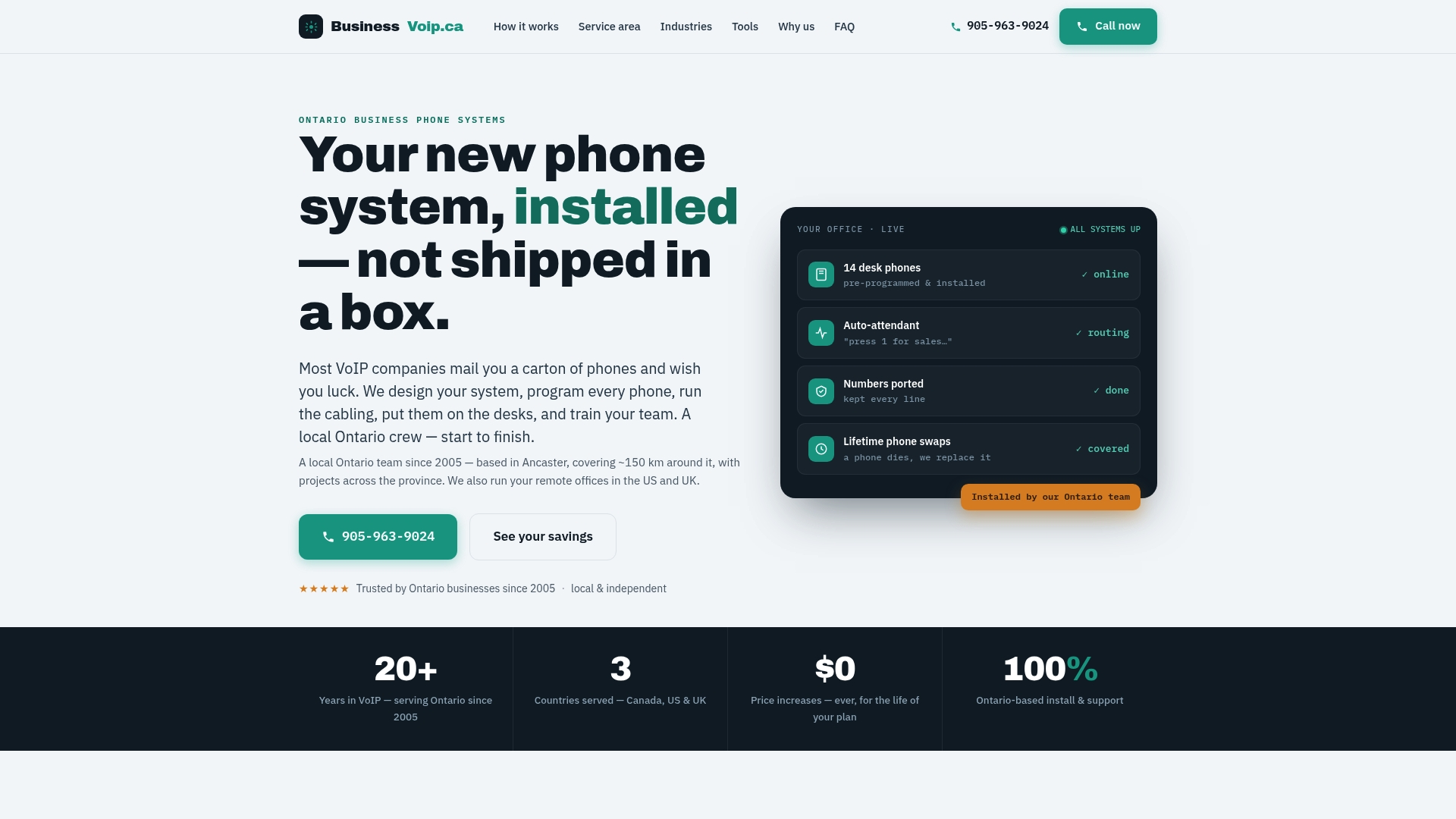
The Businessvoip team designs, programs, cables, and installs your hosted VoIP system on-site, with auto attendant configured to your exact call flow before the first call comes in. Fixed pricing means no annual increases, and rented phones carry a lifetime warranty. Businessvoip has served Ontario businesses since 2005, supporting sectors from financial services firms to property managers to moving companies, within 150 km of Ancaster and province-wide for larger projects. If your current phone system is not routing calls the way your business actually works, that is the problem Businessvoip solves.
FAQ
What is an auto attendant phone system?
An auto attendant phone system is an automated telephony feature that answers incoming calls, plays a recorded greeting, and routes callers to the correct extension or department without a live receptionist. The underlying technology is called Interactive Voice Response, or IVR.
How long does it take to set up an auto attendant?
A basic configuration on a hosted VoIP platform takes approximately 30 to 60 minutes, provided you have your call flow mapped in advance.
How many menu options should an auto attendant have?
The most effective auto attendant menus limit main options to three and always include a "Press 0" shortcut to a live person, since deeper or more complex menus increase caller hang-up rates.
What is the difference between an auto attendant and an AI receptionist?
A traditional auto attendant uses touch-tone or basic voice menus to route calls. An AI receptionist uses natural language processing to understand what a caller says, answer questions, book appointments in real time, and update CRM records automatically.
How much does a business auto attendant system cost in Ontario?
Standard hosted VoIP plans with auto attendant included typically run $15–$40 per user per month. AI-specific plans start around $59 per month for entry-level services.
Recommended
- VoIP Phone Systems for Temp & Staffing Agencies in Ontario | BusinessVoip.ca
- VoIP Phone Systems for Financial Planners & Leasing in Ontario | BusinessVoip.ca
- VoIP Phone Systems for Moving Companies in Ontario | BusinessVoip.ca
- VoIP Phone Systems for Property & Building Management in Ontario | BusinessVoip.ca